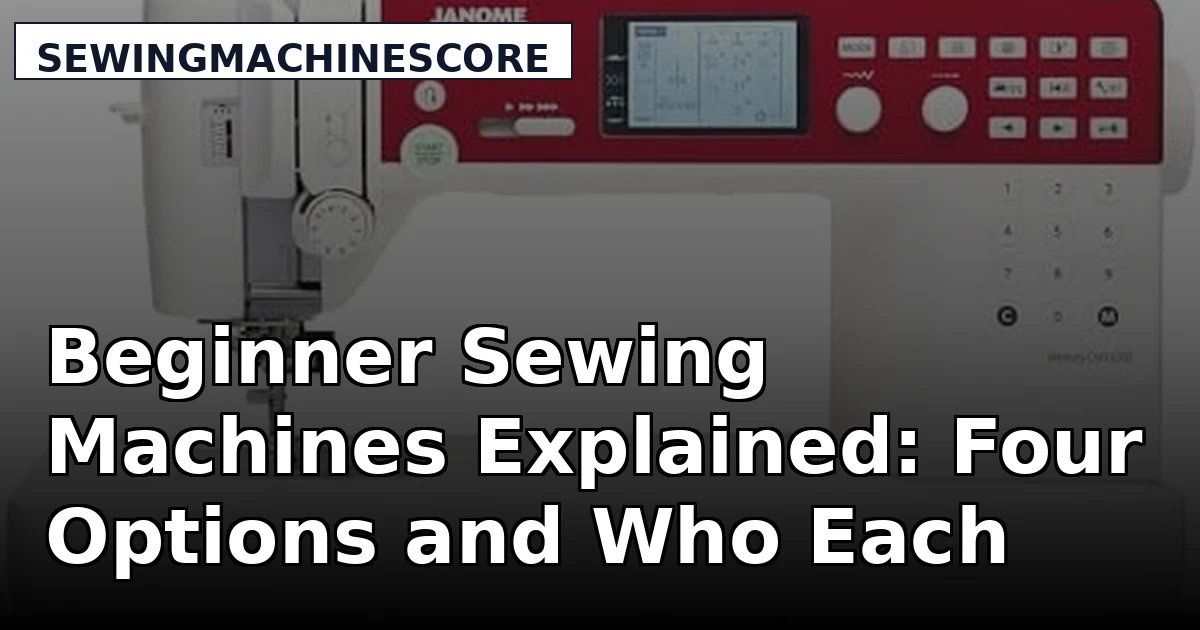
Most people shopping for beginner sewing machines are not really shopping for a machine. They are shopping for a project: a hem, a quilt, a costume, a stack of mending that has been sitting by the couch since last winter. Those projects pull in different directions, and the four machines here sit at four different points on that map. The useful question is not which one carries the longest feature list. It is which one matches the fabric and the work you actually have in front of you.
Here is what the marketing rarely says out loud: stitch count is the easiest number to advertise and the hardest number to shop by. A machine with 100 decorative stitches still sews almost every seam with one straight stitch. What decides whether you enjoy the machine in month three is whether that straight stitch holds even tension across different fabrics, whether the bobbin behaves, and whether the machine asks more patience from you than the project does.
Related: How to Test a Sewing Machine Before You Buy It →
Quick answer
There is no single right answer, but there is a short one. If you want one machine that can move between garment sewing and quilting, the Janome MC6650 Sewing and Quilting Machine is the most capable of these four. If your sewing leans toward denim, canvas, and layered seams, the Brother ST150HDH Strong and Tough Sewing Machine 50 Stitches is positioned for that work. For a first machine that fits on a small table, the SINGER® M2100 Lightweight Compact Sewing Machine with Accessory Kit is the simplest place to start. And the SINGER® M1000 (White) Portable Mending Machine with Accessory Kit covers repairs and hems without asking for a permanent spot in the house.
Four useful options
| Model | Best fit | What stands out |
|---|---|---|
| Janome MC6650 Sewing and Quilting Machine | Garment sewing and quilting in one machine | Sold as a combined sewing and quilting machine rather than a single-purpose model |
| Brother ST150HDH Strong and Tough Sewing Machine 50 Stitches | Thick fabric and layered seams | Product name specifies 50 stitches and positions the machine for strong, tough work |
| SINGER® M2100 Lightweight Compact Sewing Machine with Accessory Kit | A first machine on a small table | Lightweight, compact body with an accessory kit included |
| SINGER® M1000 (White) Portable Mending Machine with Accessory Kit | Repairs, hems, and quick fixes | Portable mending machine with an accessory kit for small jobs |
The long-term machine: Janome MC6650 Sewing and Quilting Machine
Quilting and garment sewing ask different things of a machine. Quilting wants layers fed evenly, with a walking foot or a built-in feed system doing the work of keeping three layers from shifting. Garment sewing wants control on curves, a straight stitch that does not pucker silk, and a buttonhole that comes out the same length twice in a row. A machine sold as a sewing and quilting model is built to cover both jobs, and that breadth is exactly what you pay for.
The trade-off is commitment. A machine in this class wants a dedicated table or cabinet, and it rewards a buyer who already knows they will keep sewing. If your sewing is occasional mending and the machine will live in a closet between uses, this is more machine than the job requires, and the compact options below will serve you better. Buy for the fabric you actually sew, not the fabric you hope to sew in three years.
The heavy-fabric option: Brother ST150HDH Strong and Tough Sewing Machine 50 Stitches
"Strong and tough" is a phrase stamped on a lot of machines, and it is worth knowing what it can and cannot mean. A machine that handles denim does it with a metal frame, a feed system with enough bite to move heavy layers, and a motor that does not stall when the needle meets a folded seam. Those are the things to look for in the manual and in the machine's construction, not in the badge on the front.
Fifty stitches is also plenty. A machine with 50 stitches and a straight stitch that holds tension on canvas will out-sew a machine with 200 stitches that whines on a hem. If your projects are bags, aprons, workwear repairs, or anything with a folded seam, this is the category to shop in. If your projects are quilting and light garment work, the Janome above is the better fit.
The compact first machine: SINGER® M2100 Lightweight Compact Sewing Machine with Accessory Kit
Your first machine should make you want to sew tomorrow. That is the real spec, and it is why lightweight and compact matter more than they sound. If the machine lives on a dining table and has to be moved for dinner, a lighter body is the difference between sewing twice a week and sewing twice a year. Compact also means the machine can stay out on a small desk without taking over the room.
The accessory kit is the quiet advantage here. Most first projects need a zipper foot, a buttonhole foot, extra bobbins, and a seam ripper, and buying those separately adds up fast. Check the kit contents before you buy, then check the manual for the maximum stitch width and the buttonhole type, because that is what limits what you can make. A compact machine is not a machine for quilting a king-size quilt, but it is a machine for learning, and learning is the job.
The mending machine: SINGER® M1000 (White) Portable Mending Machine with Accessory Kit
A mending machine is a specific tool, and it is worth being honest about the job it does. It repairs, hems, and patches. It is not the machine you build a Renaissance gown on, and it is not meant to be. What it does offer is the thing a full-size machine cannot: it can come to the repair instead of the repair coming to it. A hem that needs fixing while the curtains are still hanging is a job for a portable machine.
If you already own a main machine and your backlog is repairs rather than projects, this fills a gap without eating table space. If you are buying your first machine and you want to make things rather than fix things, put the budget toward the compact or heavy-fabric option instead.
Prices and availability may change. Product images, names, and retailer links must be matched by verified ASIN. Do not state a current price, rating, stock status, or measured result without current evidence.
Why stitch count is not the first question
Stitch count is a menu, not a meal. Walk through a typical project and count how many stitches you actually use: a straight stitch for seams, a zigzag for finishing raw edges, a blind hem if you are lucky, and a buttonhole. That is four. The other 46 or 196 stitches on the dial are decorative options you will reach for occasionally and then forget about.
Decorative stitches also cost you setup time. They usually want a stabilizer, a specific needle, and a tension adjustment, and they can pucker on light fabric if you skip those steps. A machine that does 50 stitches well is more useful than a machine that does 200 badly, because the four core stitches are the ones holding your project together.
So when you compare machines, compare the straight stitch first. Ask whether the machine feeds evenly at slow speed and at high speed, whether the tension dial changes the stitch in a predictable way, and whether the machine stalls or complains when the fabric gets thick. Everything else on the feature list is convenience stacked on that foundation.
Tension, bobbin, and buttonholes: what actually matters
Tension is the dial everyone touches and nobody understands. Balanced tension means the upper thread and the bobbin thread meet inside the fabric, not on top of it. When it is off, you get loops on the underside, puckers on the top, or a thread that snaps mid-seam. A machine with a tension dial that responds in small, predictable increments is a machine you can learn on, because you can diagnose a problem instead of guessing at it.
Bobbin issues sit behind a large share of the "my machine is broken" posts online, and they are usually not the machine's fault. The wrong bobbin for the model, a bobbin wound unevenly, or a bobbin case with lint in it will produce the same symptoms as a serious mechanical failure. Learn to wind a bobbin properly and to clean the bobbin case before you decide the machine is at fault.
Buttonholes are the truest test of a machine's brain. A buttonhole requires the machine to move the fabric in a precise pattern, reverse direction cleanly, and keep the stitch density consistent on both sides. A machine that produces two identical buttonholes in a row on the fabric you actually sew is a machine with solid timing and feed. If you can only test one thing in a store or from a returnable online order, test that.
A five-step way to choose
- List the three things you will actually sew in the next six months, with the fabric named. Not the projects you admire on the internet. The ones with a deadline.
- Sort that list by fabric weight. Light and drapey points to the Janome or the compact machine. Heavy and layered points to the Brother.
- Decide whether you need one machine or two. Repairs and construction are different jobs, and a portable mending machine plus a main machine is a legitimate setup.
- Compare the accessories in the box against the feet you will need. Zipper foot, buttonhole foot, and extra bobbins come first, and a walking foot matters if quilting is on the list.
- Check the return window and the warranty terms before you order, because the repair path matters more than any single feature on the spec sheet.
Practical guidance before you click buy
- Budget beyond the machine. Needles, quality thread, bobbins, a seam ripper, and a walking foot are part of the real cost of starting.
- Keep a test journal. Five fabric scraps, three stitch lengths, and a note on the result will teach you more about a new machine than any review.
- Buy for the fabric you sew now. A quilting-forward machine frustrates a garment sewer and the reverse is just as true.
- Download the manual before you buy. It lists the accessory feet, the stitch menu, and the maintenance schedule, and it answers most pre-purchase questions.
- Plan for maintenance. Lint removal after every few projects, oiling only as the manual allows, and eventually a professional service are part of owning any machine.
Which option should you choose?
Choose the Janome MC6650 Sewing and Quilting Machine when you want one machine for garment sewing and quilting, you have permanent table space, and you expect to keep sewing for years. Choose the Brother ST150HDH Strong and Tough Sewing Machine 50 Stitches when your projects lean toward denim, canvas, bags, and layered seams. Choose the SINGER® M2100 Lightweight Compact Sewing Machine with Accessory Kit when you are starting out, working on a small or shared table, and want the accessories included. Choose the SINGER® M1000 (White) Portable Mending Machine with Accessory Kit when repairs and hems are the actual job and portability is the point.
One caveat worth stating plainly: the descriptions here come from the product names and categories, not from a seam test on five fabrics. Before you buy, read the manual for the accessory list, the stitch menu, and the rated fabric thickness, and confirm the return window in case the machine does not suit the fabric you sew most.
The bottom line
Four machines, four jobs. The Janome MC6650 covers garment and quilt work in one machine and asks for space and commitment in return. The Brother ST150HDH is aimed at thick fabric and layered seams. The SINGER® M2100 is a compact first machine with the accessories already in the box. The SINGER® M1000 is a portable mending tool for repairs rather than construction.
Pick the one that matches the fabric on your table this month, not the one with the longest feature list. A machine that holds an even straight stitch on the fabric you actually sew will keep you sewing, and that is the only spec that pays off over time.