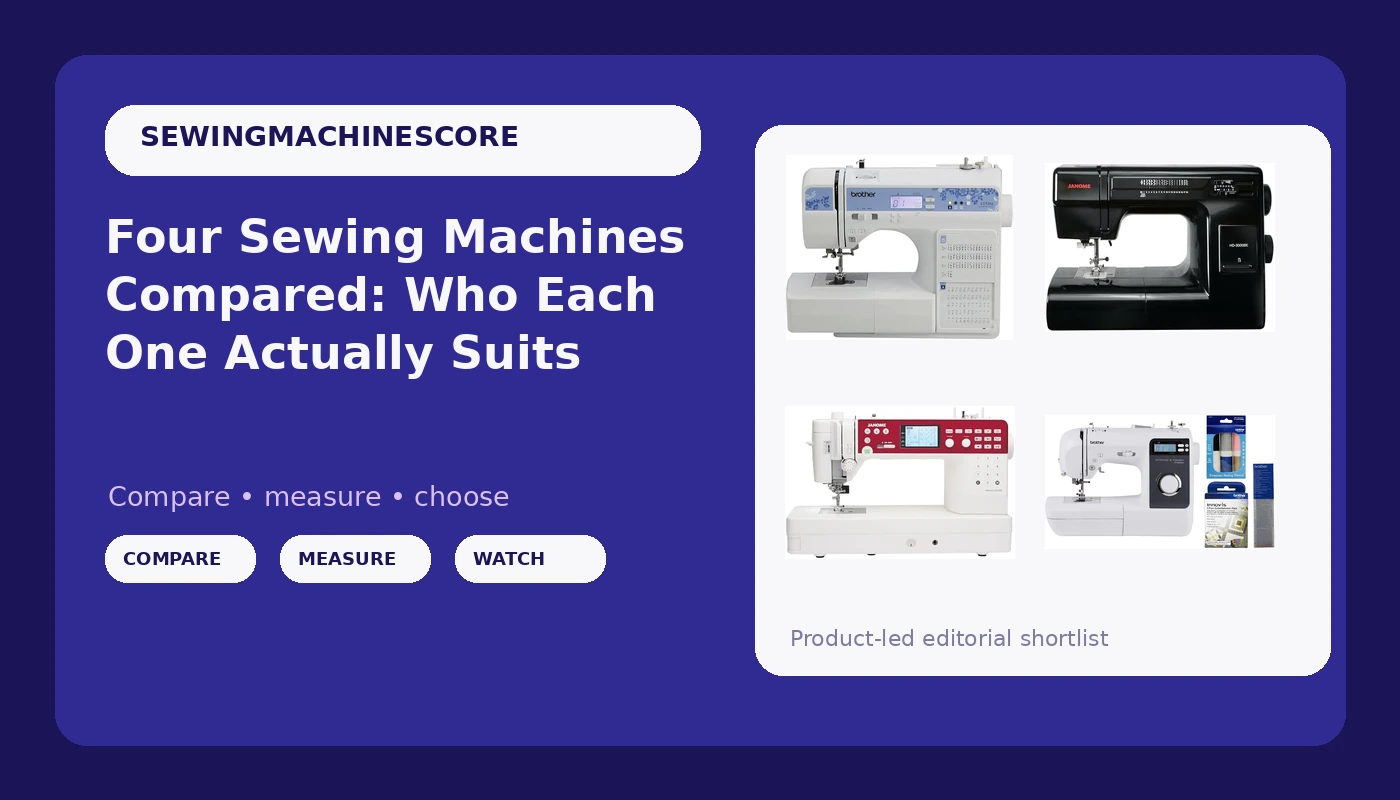
Most people who ask me which sewing machine to buy are really asking a quieter question: which machine will still be pleasant to use in month six, when the novelty has worn off and there is a half-finished project pinned on the table. The four machines in this comparison all come from Brother and Janome, and they are built around four different sets of priorities. One is loaded with stitch variety and presser feet, one is a heavy duty machine sold with a quilting kit, one is a sewing and quilting machine for someone moving up a level, and one pairs a strong and tough build with a bundle of embellishment supplies. Reading their spec sheets side by side tells you more about who each one is for than any single number does.
Related: How to Read a Sewing Machine Spec Sheet Without Getting Fooled →
Quick answer
None of these four is universally the right machine, because each one is assembled around a different set of priorities. The Brother CS7205 carries the largest supplied stitch count and the largest presser foot count in this group, along with a wide table, which suits a sewer who wants options included rather than purchased later. The Janome Heavy Duty HD-3000 Black Edition is the heavy duty option here and ships with a six-piece quilting kit. The Janome MC6650 is a sewing and quilting machine for someone who wants one machine to cover both jobs. The Brother ST150HDH pairs a strong and tough build with an LCD display and a bundle of premium thread, water-soluble stabilizer, and embellishment supplies. Decide which of those descriptions matches the sewing you actually do, then confirm the current details on the listing.
Four useful options
| Model | Best fit | What stands out |
|---|---|---|
| Brother CS7205 Computerized Machine | Sewers who want variety and accessories in one box | 150 built-in stitches, 1 font, wide table, 11 sewing feet |
| Janome Heavy Duty HD-3000 Black Edition Sewing Machine | Sewers who want a heavy duty machine and quilting accessories together | Heavy duty designation, black edition finish, bonus 6-piece quilting kit |
| Janome MC6650 Sewing and Quilting Machine | Someone who wants one machine for both garments and quilts | A sewing and quilting machine built as a step-up model |
| Brother ST150HDH Strong & Tough Sewing Machine | Decorative work and embellishment on sturdy fabric | 50 built-in stitches, LCD display, premium thread 6-pack, water-soluble stabilizer, 5-foot embellishment pack |
The all-rounder: Brother CS7205 Computerized Machine
The argument for this one is breadth. Eleven feet means you are not stopping mid-project to order a zipper foot or a blind hem foot, and a wide table changes what the machine can physically hold while you work. The trade-offs are worth naming. A wide table takes up space on a dining table that a serger may already be sharing. A 150-stitch menu includes plenty of stitches most sewers never touch, which is fine as long as you are not paying attention to the count instead of the quality of the basic straight stitch. And computerized machines concentrate a lot of function in electronics, so if something fails out of warranty, the repair bill can be a meaningful fraction of what the machine originally cost. That is the real bargain you make with any computerized model, not just this one.
The heavy duty pick: Janome Heavy Duty HD-3000 Black Edition Sewing Machine with Bonus 6 Piece Quilting Kit
"Heavy duty" is a phrase stamped on a lot of machines that do not deserve it, and I am suspicious of it as a category. What this listing actually tells you is narrower and more useful: it is a Janome heavy duty model, finished in black, and it comes with a six-piece quilting kit. The kit is the part that decides whether this machine fits you. If you quilt, a bundled accessory set saves you a round of separate shopping and gets you working sooner. If you sew garments and never plan to piece a quilt, that same kit is shelf clutter and you are paying for accessories you will not open. Buy the bundle only when you want the bundle.
The quilting step-up: Janome MC6650 Sewing and Quilting Machine
This is the machine in the group that asks the most of your budget and gives the most in return if you are the right sewer. In my classes I lean on Janome for garment work because the tension dial tends to behave the way the numbers suggest, and a tension dial that means something is the difference between adjusting and guessing. The honest trade-off is that a quilting-capable machine only pays off if you quilt. If your projects are dresses, costumes, and hemmed curtains, you are buying capability you will rarely call on, and a simpler machine would leave more money for fabric. If you piece and quilt and also want to sew garments without owning two machines, this is the category to look at.
The embellishment bundle: Brother ST150HDH Strong & Tough Sewing Machine
The bundle here is aimed at decorative work. Water-soluble stabilizer and an embellishment pack are the supplies you reach for when you are stitching something that has to look intentional rather than structural, and a six-pack of premium thread means you are not starting with the spool that came in the box. The trade-off is the stitch count. Fifty built-in stitches is a modest number next to the 150 on the CS7205, and I say that as someone who tells beginners that a 100-stitch machine uses about ten of them. Fifty stitches is not a limitation for most sewing, but if a long menu of decorative patterns is the reason you are shopping, know what you are choosing. An LCD display is a genuine convenience for selecting stitches and reading settings, with the same electronics caveat that applies to any display-driven machine.
Prices and availability may change. Product images, names, and retailer links are matched to verified listings. No current price, rating, stock status, or measured result is stated here without current evidence.
What a stitch count actually tells you
Stitch count is the most marketed number on a sewing machine and the least useful one on its own. A machine with 150 stitches and a machine with 50 stitches both use a straight stitch for the overwhelming majority of what they sew. Seams, hems, and topstitching are all the same basic stitch at different lengths and positions. The extra patterns are for decorative work, and if you do not do decorative work, you are comparing menus you will never order from.
What actually separates machines is smaller and harder to market. The quality of the straight stitch across different fabrics. Whether the tension dial produces a visible, predictable change when you turn it. Whether the machine stays calm when you feed it several layers of something thick, or starts making the noise that tells you the motor is working harder than it wants to. Buttonholes tell you more about a machine's brain than its stitch menu does, because a buttonhole requires the machine to move the fabric in a controlled sequence and get back to where it started. That is engineering, not a feature list.
None of those things are printed on a spec sheet, which is why the spec sheet should be a filter rather than a verdict. Use it to eliminate machines that clearly do not fit, then judge the survivors on the parts that matter.
Matching the machine to the fabric you sew
Buy for the fabric you actually sew, not the fabric you imagine sewing. A quilter who pieces cotton and binds quilts needs different things from a sewer who works with stretch knits, and both need different things from someone making structured costumes out of heavy fabric with interfacing.
If your projects are garments, prioritize stitch quality and tension control. You will spend your time on seams and finishes, and a machine that handles a range of fabric weights without complaining will matter more than any accessory.
If your projects are quilts, the bundle matters. A quilting kit or a quilting-capable machine saves you from buying the same accessories one at a time, and a wide table earns its space when you are managing a full quilt rather than a single block.
If your projects are decorative, look at what supplies come with the machine and what stitch menu it offers, because that is where the money goes in that kind of sewing.
Here is the order I would work through it:
- Write down the last three things you actually sewed, not the three things you hope to sew.
- Decide whether those projects need decorative stitches, quilting accessories, or neither.
- Compare the machines that survive step two on stitch quality and tension behavior rather than on stitch count.
- Check what is included in the box, since a bundled kit or a set of presser feet changes the real cost of a machine.
- Confirm the current details on the listing before you commit, because bundles and availability change.
Practical notes before you click buy
- Count your presser feet. Eleven feet included is a different purchase than a machine where you buy each foot separately.
- Decide whether you want a wide table before you fall for one. It is genuinely useful and it genuinely takes up room.
- Treat a quilting kit as a real part of the value only if you quilt. Otherwise it is a box you store.
- Ask what happens when the electronics fail. Computerized and display-driven machines are convenient right up until the repair quote arrives.
- Remember that an automatic needle threader is a convenience, not a foundation. If it breaks in month two, the machine still has to sew well without it.
- Do not let a stitch count talk you out of a machine with a better straight stitch.
Which option should you choose?
Choose the Brother CS7205 Computerized Machine when you want the widest set of stitches and presser feet in one purchase and a wide table for larger projects. Choose the Janome Heavy Duty HD-3000 Black Edition Sewing Machine with Bonus 6 Piece Quilting Kit when you want a heavy duty machine and you will genuinely use the quilting accessories that come with it. Choose the Janome MC6650 Sewing and Quilting Machine when you want a single step-up machine to cover both garment sewing and quilting. Choose the Brother ST150HDH Strong & Tough Sewing Machine when your work leans toward embellishment and decorative stitching and you want thread, stabilizer, and an embellishment pack in the box with it.
There is a limit to what any comparison of listings can tell you. Stitch counts, included accessories, and product descriptions are facts you can verify; how a machine feels on the fabric you sew is not something a spec sheet can answer. If you can try a machine in person before buying, do it, and bring the fabric you sew most. If you cannot, buy from a listing with a return policy you have actually read.
The bottom line
These four machines are not ranked versions of the same thing. They are four answers to four different questions. The Brother CS7205 answers "I want options and accessories included." The Janome HD-3000 Black Edition answers "I want a heavy duty machine and I quilt." The Janome MC6650 answers "I want one machine for garments and quilts." The Brother ST150HDH answers "I want a strong machine and the supplies for decorative work." Pick the question that matches your sewing, check the listing for current details and availability, and spend your remaining budget on fabric. The machine is the tool; the fabric is where the work happens.