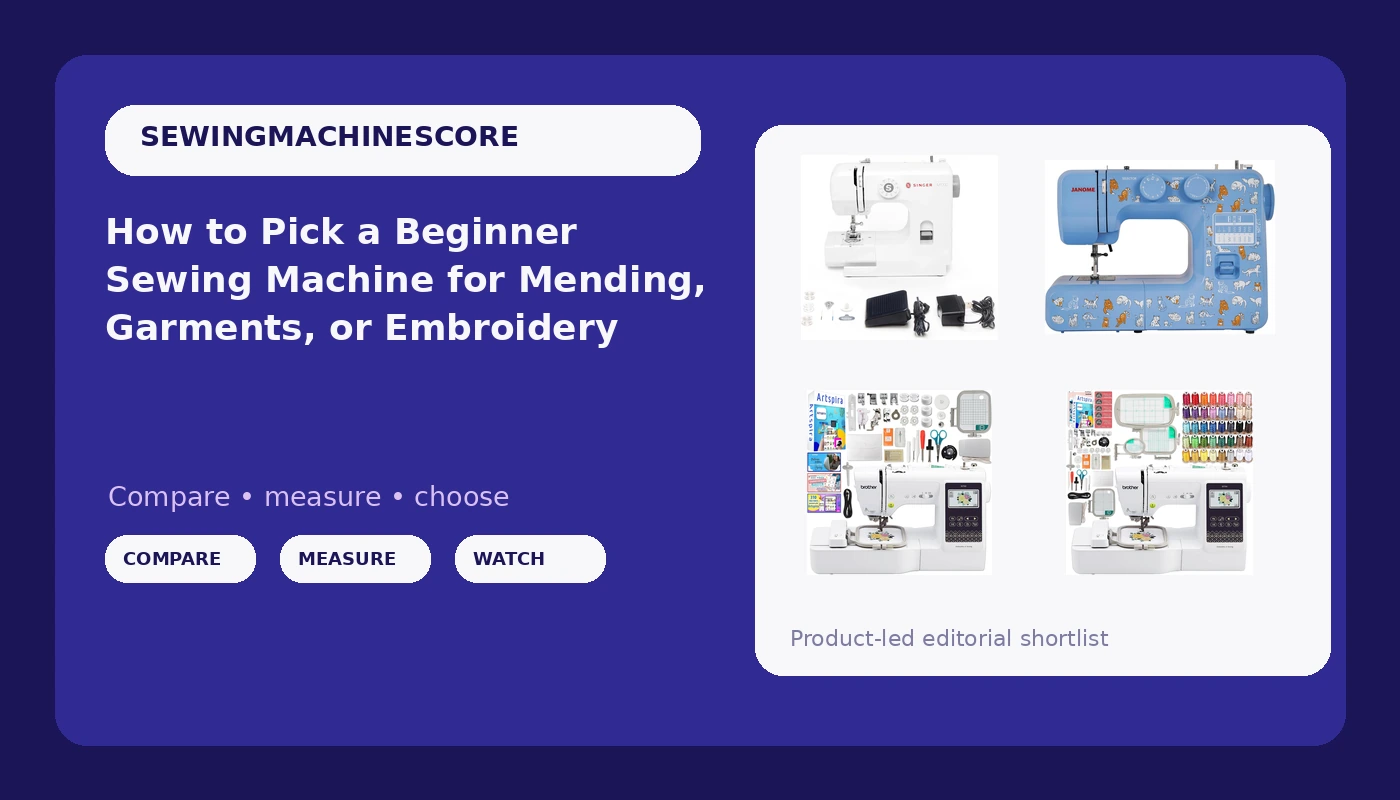
Beginner sewing machines are sold in three very different shapes, and the label on the box rarely explains which shape you are looking at. One is a small mending tool built for hems and seams. One is a full-size machine aimed at garments, patchwork, and light quilting. One is a combo unit that sews and embroiders, and it is sold in more than one bundle with different accessories in the box. Buying the wrong shape is the most common first-machine mistake, and it is not a mistake the price tag warns you about. This explainer goes through four specific machines, what each one is designed to do, and how to decide which of them fits the sewing you actually have planned.
Related: How to Read a Sewing Machine Spec Sheet Without Getting Sold →
Quick answer
If your projects are repairs, the SINGER M1000 Portable Mending Machine is the smallest and most narrowly focused option here. If you want one machine for garments, patchwork, and light quilting, the Janome Cat Fancy is the one aimed at beginners. If you want sewing and embroidery in a single unit, the two Brother SE700 bundles are the same machine with different accessory packages, and the choice between them comes down to how many hoops and how much embroidery thread arrive in the box.
Four useful options
| Model | Best fit | What stands out |
|---|---|---|
| SINGER® M1000 (White) Portable Mending Machine with Accessory Kit | Quick repairs and small mending jobs | A portable mending machine sold with an accessory kit |
| Janome Cat Fancy Easy-to-Use Sewing Machine with Interior Metal Frame, Bobbin Diagram, Tutorial Videos, Made with Beginners in Mind for Garments, Patchwork, Light Quilting | First garment and patchwork machine | Interior metal frame, bobbin diagram, and tutorial videos for beginners |
| Brother SE700 Combo Embroidery & Sewing Machine with 4" x 4" Embroidery Hoop and 40+ Accessories | Sewing plus starter embroidery | Includes a 4 inch by 4 inch embroidery hoop and 40+ accessories |
| Brother SE700 Combo Embroidery & Sewing Machine with 4 Embroidery Hoops, Embroidery Thread Set & Accessories | Sewing plus a fuller embroidery setup | Includes four embroidery hoops and an embroidery thread set |
The mending option: SINGER® M1000 (White) Portable Mending Machine with Accessory Kit
The M1000 is the narrowest tool of the four. A mending machine is built around short, straight jobs: a split seam, a hem that dropped, a cuff that needs taking in. It is not built to run long garment seams, and it is not built for embroidery. If your list of projects is mostly repair, this is the shape of machine that matches it, and the included accessory kit covers the small parts those jobs tend to need. If your list includes making a dress from a pattern, this is the wrong tool, and no accessory kit changes that. The honest trade-off is scope. You give up bed space, stitch variety, and the ability to grow into larger projects in exchange for a small machine that handles repairs without committing a permanent spot on the table.
The beginner garment option: Janome Cat Fancy Easy-to-Use Sewing Machine with Interior Metal Frame, Bobbin Diagram, Tutorial Videos, Made with Beginners in Mind for Garments, Patchwork, Light Quilting
The Janome Cat Fancy is the machine in this group explicitly aimed at beginners, and the details in its name point at why. An interior metal frame is a structural choice: metal inside the housing resists the flex that makes a machine feel vague when you push fabric through it, and that firmness shows up in how consistently a seam feeds. The bobbin diagram and tutorial videos are teaching features, which matter more than they sound, because bobbin threading sits behind a large share of the "my machine is broken" problems beginners run into. Garments, patchwork, and light quilting are the three jobs named, and that is a coherent set, since all three rest on a standard straight stitch with a handful of utility stitches around it. Read "light quilting" literally. It describes a machine that will handle a quilted project, not one built to push a king-size quilt through a small throat space for hours at a time.
The embroidery starter bundle: Brother SE700 Combo Embroidery & Sewing Machine with 4" x 4" Embroidery Hoop and 40+ Accessories
The two SE700 bundles are the same combo machine, which is the first thing to understand before comparing them. A combo unit sews and embroiders, so it replaces two machines on your table, and it carries the trade-offs that come with any machine doing two jobs. The embroidery field is defined by the hoop, and a 4 inch by 4 inch hoop is a small field. That size handles monograms, small motifs, patch designs, and a name on a collar. It does not handle a large back-of-jacket design in a single hooping. The 40+ accessories are the practical half of this purchase, because embroidery consumes stabilizer, bobbins, and needles at a rate plain sewing does not. If you are new to embroidery and unsure how far you will take it, this is the bundle that lets you find out without buying a second set of hoops up front.
The embroidery expanded bundle: Brother SE700 Combo Embroidery & Sewing Machine with 4 Embroidery Hoops, Embroidery Thread Set & Accessories
This bundle is the same Brother SE700 machine with a bigger accessory package: four embroidery hoops and an embroidery thread set. The thread set is the part that changes the first week of ownership, because a machine that arrives with thread can be run the day it is unboxed, and embroidery thread in a range of colors is what makes a design look finished rather than sampled. Four hoops means a range of embroidery fields rather than one fixed size, which starts to matter as soon as you move past monograms. The trade-off is the same as any bundle. You pay for accessories up front instead of buying them one at a time later. If you already know embroidery is the point of the purchase, having the hoops and thread in the box is the simpler path. If you are still deciding whether embroidery is for you, the smaller bundle leaves that door open at a lower entry point.
Prices and availability may change. Product images, names, and retailer links must be matched by verified ASIN. Do not state a current price, rating, stock status, or measured result without current evidence.
What the labels on these machines actually mean
Four product names, four different vocabularies, and each one is telling you something specific if you know how to read it.
"Mending machine" is a scope statement. It says the machine is built for repairs on existing items, not for cutting and constructing new ones from a pattern. That is a real limitation, not a marketing hedge.
"Interior metal frame" is a construction statement. It describes what is holding the needle and feed mechanism steady inside the housing. A frame like that is one of the reasons two machines with similar stitch lists can feel completely different under the needle.
"Combo embroidery and sewing" is a two-jobs-one-machine statement. It means the unit has both a sewing bed and an embroidery arm or carriage, and that the embroidery capability is bounded by the hoops that fit it. The hoop size is the number that matters, more than the stitch count or the design library.
"40+ accessories" and "embroidery thread set" are packaging statements, not capability statements. They describe what is in the box. A large accessory count usually means bobbins, needles, a seam ripper, a foot or two, and assorted notions. It is genuinely useful, and it is not the same thing as a wider range of sewing ability.
The pattern to notice is that the most useful words in these names are the specific ones. Hoop dimensions, frame material, and named use cases tell you what a machine will do. Round numbers and exclamation-free accessory counts tell you what you will be unpacking.
A short method for matching a machine to your sewing
Before comparing features, compare the machine to your actual project list. Work through these five steps in order, and the shortlist tends to shrink on its own.
- Write down the last five things you sewed, repaired, or wished you could make. Real projects, not aspirational ones.
- Sort that list into three buckets: repairs, construction, and decorative work. Repairs means hems and seams. Construction means cutting fabric and building a garment. Decorative means embroidery, applique, and embellishment.
- If decorative work appears anywhere on the list, decide what size the design needs to be. That answer determines the minimum hoop you can live with, and hoop size is the hard limit on a combo machine.
- Decide whether you want one machine or two. A combo unit saves space and setup time, and a dedicated machine for each job is easier to grow with and easier to replace when one half wears out.
- Budget for consumables, not just the machine. Needles, bobbins, stabilizer, and thread are ongoing costs, and embroidery raises all of them.
Practical guidance for your first year
- Buy for the fabric you actually sew. A machine chosen for quilting frustrates someone who sews garments, and the reverse is just as true.
- Keep a seam journal. Note the fabric, the stitch length, and whether the result was acceptable. Six months of notes will teach you more about your machine than any manual.
- Learn to set tension by testing on scraps before you touch a real project. Tension is the dial everyone adjusts and few people understand, and balanced tension is most of what people mean when they call a stitch quality good.
- Treat the needle threader and other conveniences as bonuses, not requirements. If one breaks, you should still be able to thread the machine and keep sewing.
- Plan for maintenance. Lint builds up, needles dull, and a machine that skips stitches is often just overdue for a clean and a new needle.
Which option should you choose?
Choose the SINGER® M1000 (White) Portable Mending Machine with Accessory Kit when your sewing is mostly repairs and you want a small machine for hems, seams, and quick fixes. Choose the Janome Cat Fancy Easy-to-Use Sewing Machine with Interior Metal Frame, Bobbin Diagram, Tutorial Videos, Made with Beginners in Mind for Garments, Patchwork, Light Quilting when you want one full-size machine for garments, patchwork, and light quilting, and you value the beginner-oriented learning materials. Choose the Brother SE700 Combo Embroidery & Sewing Machine with 4" x 4" Embroidery Hoop and 40+ Accessories when you want to try embroidery alongside regular sewing without committing to a large hoop setup. Choose the Brother SE700 Combo Embroidery & Sewing Machine with 4 Embroidery Hoops, Embroidery Thread Set & Accessories when you already know embroidery is a serious part of your plan and you would rather have the hoops and thread from day one.
The caveat is that this comparison relies on manufacturer descriptions and product names, not on hands-on testing of these specific units. Hoop dimensions, frame material, and included accessories are stated facts. How a machine feels on a particular fabric is not, and it is the part you can only judge by running a test seam yourself. Availability and bundle contents can also change, so confirm the details on the product page before you buy.
The bottom line
These four machines are not competing for the same buyer. They are four different answers to the question of what you plan to sew. Repairs point to the portable mending machine. Garments and patchwork point to the beginner-focused Janome. Sewing plus embroidery points to the Brother SE700, and the only real decision there is whether you want the bundle with one small hoop or the bundle with four hoops and thread. Start from your project list, not from the feature list, and the choice becomes much less complicated.