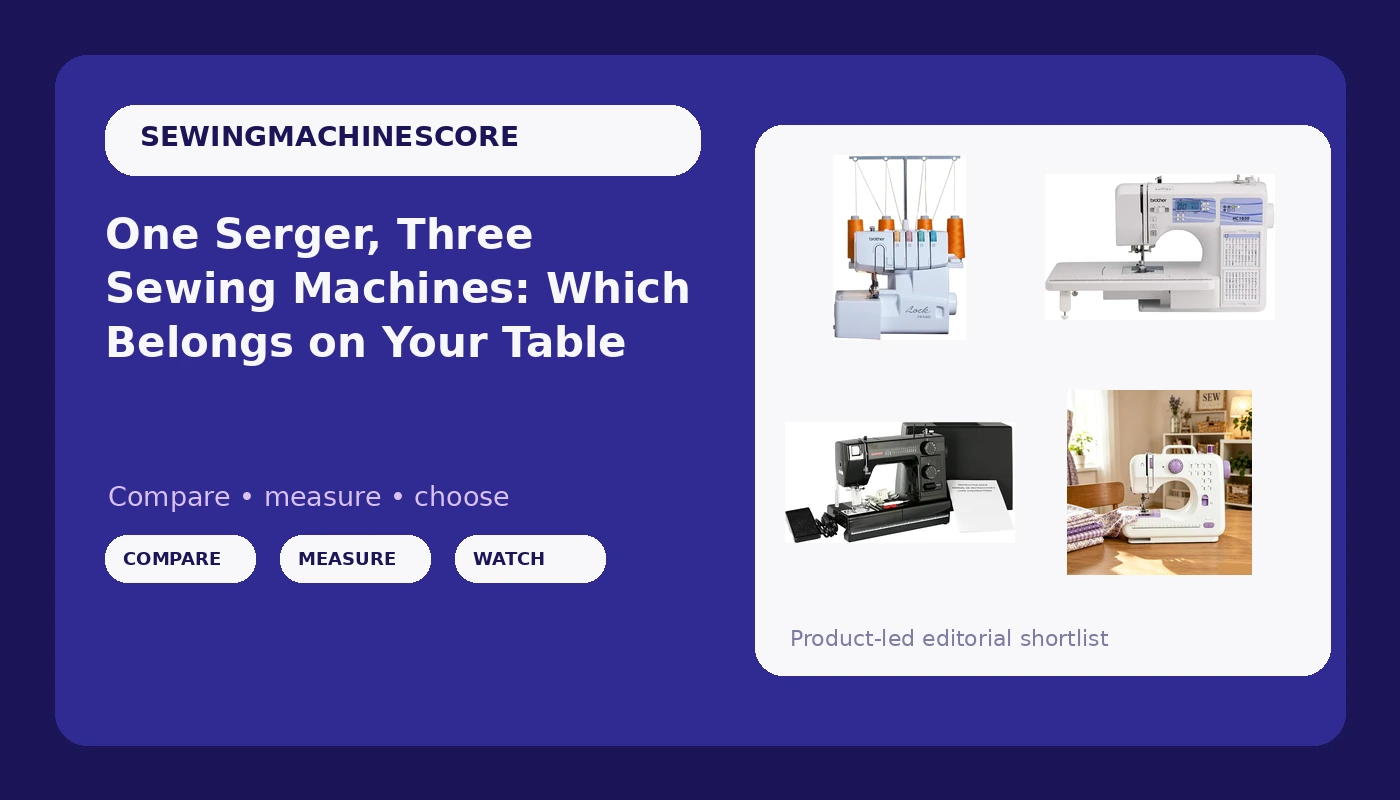
I have sewn costumes for twelve years, taught beginner classes for six of them, and kept a seam test journal the entire time: five fabric types, three stitch lengths, and a verdict on every machine that has crossed my table. That journal is why I get asked, roughly once a week, what the best sewing machine for beginners actually is. The honest answer is that there is no single answer, because the four machines in this comparison do four different jobs. One is a serger. One is a sewing and quilting machine with a screen and a large stitch library. One is an all metal garment workhorse. And one is a small electric machine sold for quick repairs, crafts, and gifts.
Buy the wrong one of those four and you will not hate sewing. You will just quietly stop, which is worse.
Related: How to Read a Sewing Pattern Without Panicking
For most people learning to sew garments, the Janome HD1000BE is the machine I would hand over first. For a beginner who wants to try quilting, decorative stitches, and a bit of everything, the Brother HC1850 is the one I would hand over instead. The Brother 1034D is not a substitute for either of them, because a serger is a different tool with a different job. And the small electric machine is not a substitute for anything. It is a repair kit that sews.
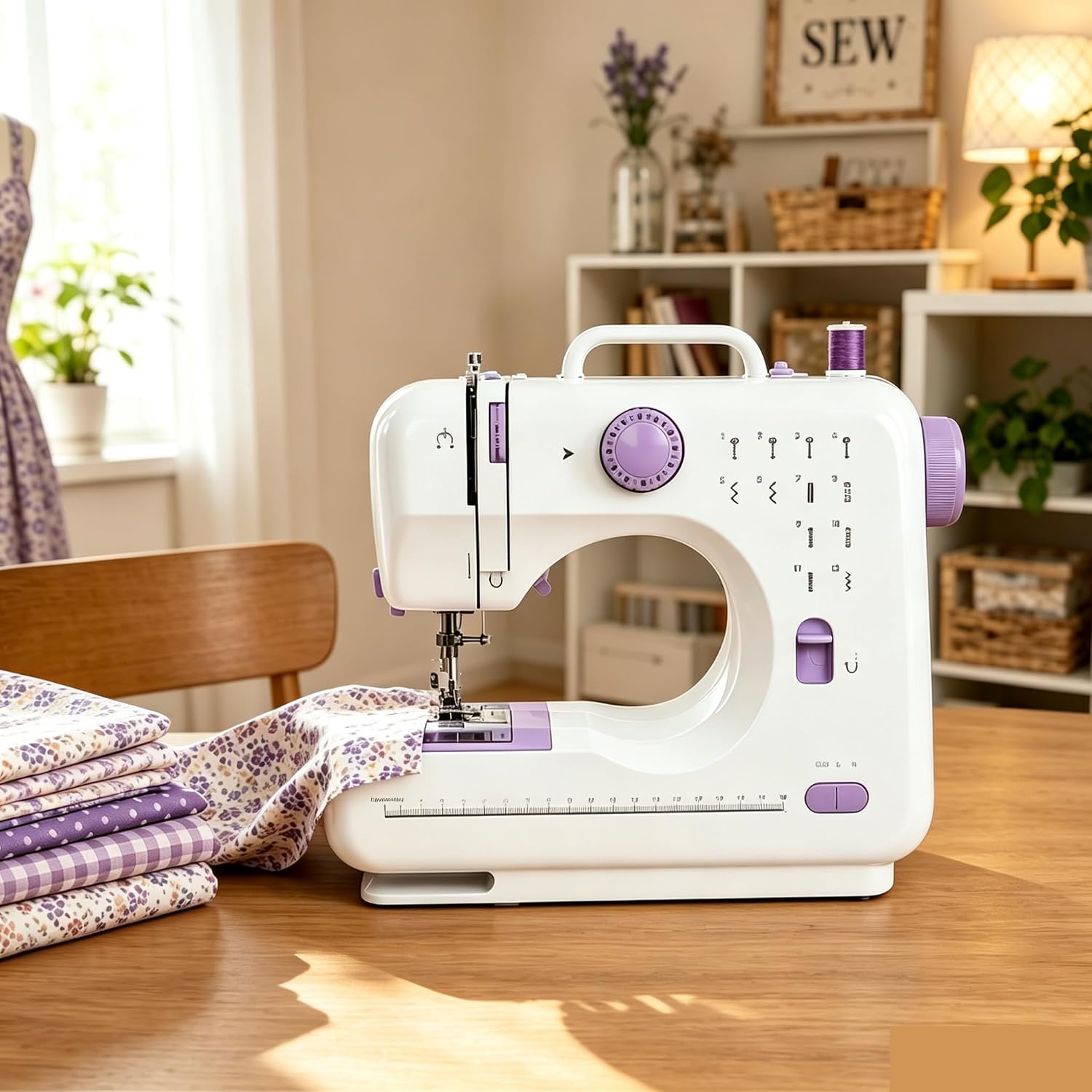
Electric Sewing Machine for Beginners for Quick Repairs DIY Crafts & Gift
The lowest-stakes way into the hobby, small enough to live in a closet, genuinely useful for hems and mending
Built for repairs and crafts, not for seams that have to hold, and not something I would put near a costume
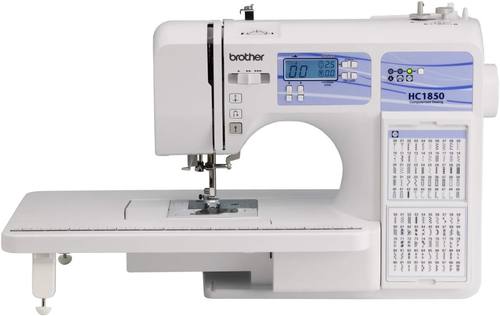
Brother HC1850 Sewing and Quilting Machine, 185 Built-in Stitches, LCD Display, 8 Included Feet
The widest range here: a large stitch library, a screen to pick from it, and eight feet in the box
A computer and a plastic-heavy frame, which is exactly what you are betting against long term
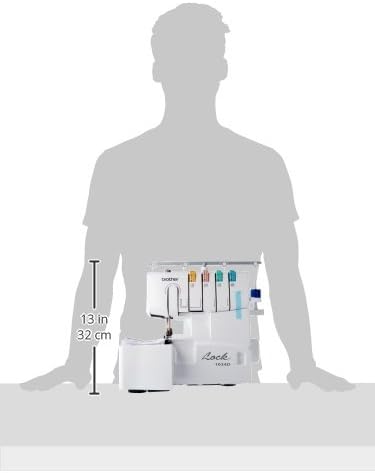
Brother 1034D Serger Overlock Sewing Machine
Finishes seam edges in one pass and makes the inside of a garment look like the outside
It is not a sewing machine, and it cannot be your only machine
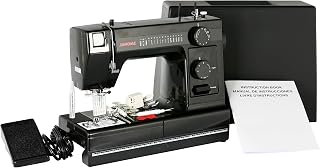
Janome HD1000BE HD1000 Black Edition All Metal Body Sewing Machine, one size
An all metal body and a design brief that says sew a lot, for a long time
Fewer stitches, more weight, and nothing here for the quilter or the crafter
Prices and availability were captured from Amazon Creators API and may change.
Why these four do not actually compete
Most comparison articles pretend every machine is a candidate for the same purchase. These four are not, and pretending otherwise is how beginners end up with a serger they cannot thread and no machine to sew a zipper on.
Sort them by the job, not the price tag. The small electric machine is for mending and small crafts. The Brother HC1850 is a general sewing and quilting machine with a large built-in stitch library and an LCD display for choosing from it. The Janome HD1000BE is a garment machine built around a metal frame. The Brother 1034D is a serger, which is a finishing tool that lives next to a sewing machine, not instead of one.
Two of these are the same purchase decision. The other two are not decisions at all until you know what you sew.
I want to be upfront about something, because it matters more than a spec table. I have not run a full seam test on all four of these machines, and a review without one is a spec sheet with attitude. So what follows is reasoning from design and from the fabric behavior I have watched for twelve years, plus a clear note on where I would need a bench test before I made a stronger claim.
The small electric machine: a repair kit that sews
The Electric Sewing Machine for Beginners for Quick Repairs DIY Crafts & Gift is the machine most beginners buy first and the one most likely to be in a closet by February. I understand the appeal completely, and I am not going to sneer at it.
What it is good at: a hem that came down the morning of a school event, a split seam on a cushion, a patch on a costume, a first project where the entire point is learning how the needle, the presser foot, and the feed dogs behave together. It is small, it is light, and the cost of finding out whether you enjoy this hobby is low. That has real value. My grandmother learned on worse.
What it is not: a garment machine. The listing names quick repairs, DIY crafts, and gifts, and that is an accurate description of the job. Nothing in that description covers a seam that has to hold on a fitted bodice, a zipper set into a wool coat, or anything you would charge money for. Those jobs need a frame that does not flex and tension control that responds to the dial, and that is not what this category of machine is built to deliver.
The other thing my students hate hearing: machines in this class are generally not built to be repaired. When they stop, they tend to stay stopped. If you bought one as a mending tool, that is a fair trade. If you bought one as your only sewing machine and you have a faire in three weeks, it is a bad bet.
Brother HC1850: the machine with the most options
185 built-in stitches, an LCD display, and eight included feet. That is the pitch, and I want to separate those three numbers by how much they matter.
The stitch count is the least important. I have said this a hundred times in class: a 100-stitch machine uses about ten, and the other ninety are variations on the same two or three mechanics with different widths and lengths. You will use a straight stitch, a zigzag, a stretch stitch, a blind hem, and a buttonhole. Everything else is a party trick you try once. So do not let 185 sell you anything by itself.
The eight feet matter much more. Accessories are where a machine's real range lives, because a foot changes what the machine can physically do rather than what it can decorate. A zipper foot, a blind hem foot, and a buttonhole foot turn one machine into several tools. When you compare a machine with eight feet against a machine with two, you are not comparing stitch libraries. You are comparing what you can attempt on a Tuesday night.
The LCD display is the honest trade-off. Menus are genuinely easier than dials when you are hunting for stitch number 74, and the screen is how a machine this feature-dense stays usable. It is also one more thing that can fail. Computerized features are wonderful right up until the board dies and the repair quote arrives, at which point a mechanical machine looks like wisdom. I would still buy the HC1850 for a beginner who wants to try everything, because the range is the point at this stage. I would just buy it knowing what I was betting on.
Where it loses to the Janome: the frame. The HC1850 is a plastic-bodied machine with a computer in it. That is fine for a hobbyist who sews a few hours a week and wants options. It is not what I would choose for someone whose machine runs daily.
Brother 1034D: the serger, reviewed as a serger
I do not do serger versus sewing machine arguments, because they are not rivals. They are different tools, and I review them separately. But since this machine is in the comparison, here is the honest framing.
A serger trims and overcasts a raw edge in one pass. That is its job. It finishes the inside of a garment so the fabric stops fraying and the seams look intentional. For costume work, where you are handling knits, slippery linings, and fabric that sheds everywhere, a serger is the difference between a costume that survives a season of performances and one that comes apart in the dressing room.
What a serger does not do: buttonholes, zippers, topstitching, or anything that needs a normal presser foot and a normal needle plate. It also does not replace the machine you already own. If you can only buy one machine, buy the sewing machine. If you already have a machine you like and you are tired of finishing every seam edge with a zigzag, this is the upgrade that changes how your work looks on the inside.
The real cost of a serger is not money, it is threading. Sergers use loopers as well as needles, the thread path is a puzzle, and the order you thread it in matters. Every serger owner I know has a story about the first time they pulled all the threads out and had to start over. That is a one-week learning curve, not a permanent problem, but plan for it. Do not buy a serger the week before a deadline.
Janome HD1000BE: the all metal argument
All metal body. That phrase is doing real work here, and it is the opposite of the phrase I complain about most, which is heavy duty stamped on a plastic machine.
A metal frame is not a luxury feature. It is the reason a straight stitch stays consistent when the fabric gets thick, because the machine does not flex under the load. When a plastic-bodied machine hits a denim seam or a folded waistband, you hear it. The pitch changes, the stitch length wanders, and you start helping the fabric through by hand, which is how needles break. A rigid frame is the foundation that everything else is convenience on top of.
That is also why the HD1000BE is the machine in this group I would point a garment sewer toward. It is built around the thing that matters most, which is straight stitch quality on the fabrics you actually sew. The Black Edition finish is cosmetic, and I will not pretend otherwise, but the body underneath it is the whole reason to buy the machine.
Where it loses: range. There is no screen, no large decorative library, and nothing here aimed at the quilter who wants to try a hundred stitch patterns. If you want to make a quilt with fancy stitching, this is not your machine, and the HC1850 is. If you want to make a coat, a bodice, or a set of curtains that hang straight, this is the one, and it will still be doing it in fifteen years.
The weight is a genuine consideration. A metal machine is not a machine you carry to a class in a tote bag without thinking about it. That is the trade for the rigidity.
Buttonholes and tension: what actually separates these four
A machine's buttonholes tell you more than its stitch count ever will. A buttonhole asks the machine to do everything at once: move the fabric precisely, keep the stitch width consistent on both sides, and stop where it started. It is the truest test of the machine's brain, and it is the first thing I run when a machine lands on my bench.
Here is the practical version. If you sew garments, you need a real buttonhole, and you need one that repeats. A machine sold for quick repairs and crafts is not where you look for that. A machine with a screen and a full stitch library is built for it. The all metal garment machine is built for the fabric, and its buttonhole is the reason the metal frame matters, because a buttonhole on a shifting frame comes out lopsided.
Tension is the other separator, and it is the dial everyone touches and nobody understands. Balanced tension is the whole craft. A machine with meaningful tension control lets you move between silk and denim and adjust for each one. A machine where the dial does almost nothing forces you to compensate with stitch choice and speed, which works until it does not. If you take one thing from this comparison, take this: the machine that handles both a slippery lining and a thick seam without whining is the one worth your money.
What I would buy for which sewer
The absolute beginner who is not sure yet: the small electric machine, bought with clear eyes as a mending tool. Learn whether you like the feel of fabric under a needle. Do not expect it to make a garment.
The beginner who wants one machine that does a bit of everything: the Brother HC1850. The stitch library, the screen, and the eight feet give you the most to explore, and the range is what keeps a new sewer interested.
The garment sewer who is done fighting their machine: the Janome HD1000BE. Buy for the fabric you actually sew, and if that fabric is wool, denim, and lining, buy the metal frame.
The sewer who already has a machine they like: the Brother 1034D. It will not replace what you own, and it will make the inside of everything you make look finished.
What I am checking next
I have a stack of beginner machines going through a tension test right now, the same thread and the same five fabrics on every one, and a buttonhole marathon at the end of it. That is the test that separates the machines that flatter a new sewer from the ones that teach bad habits. When the results are in, I will update this comparison with what the seam tests actually say, including the ones that disagree with everything above.