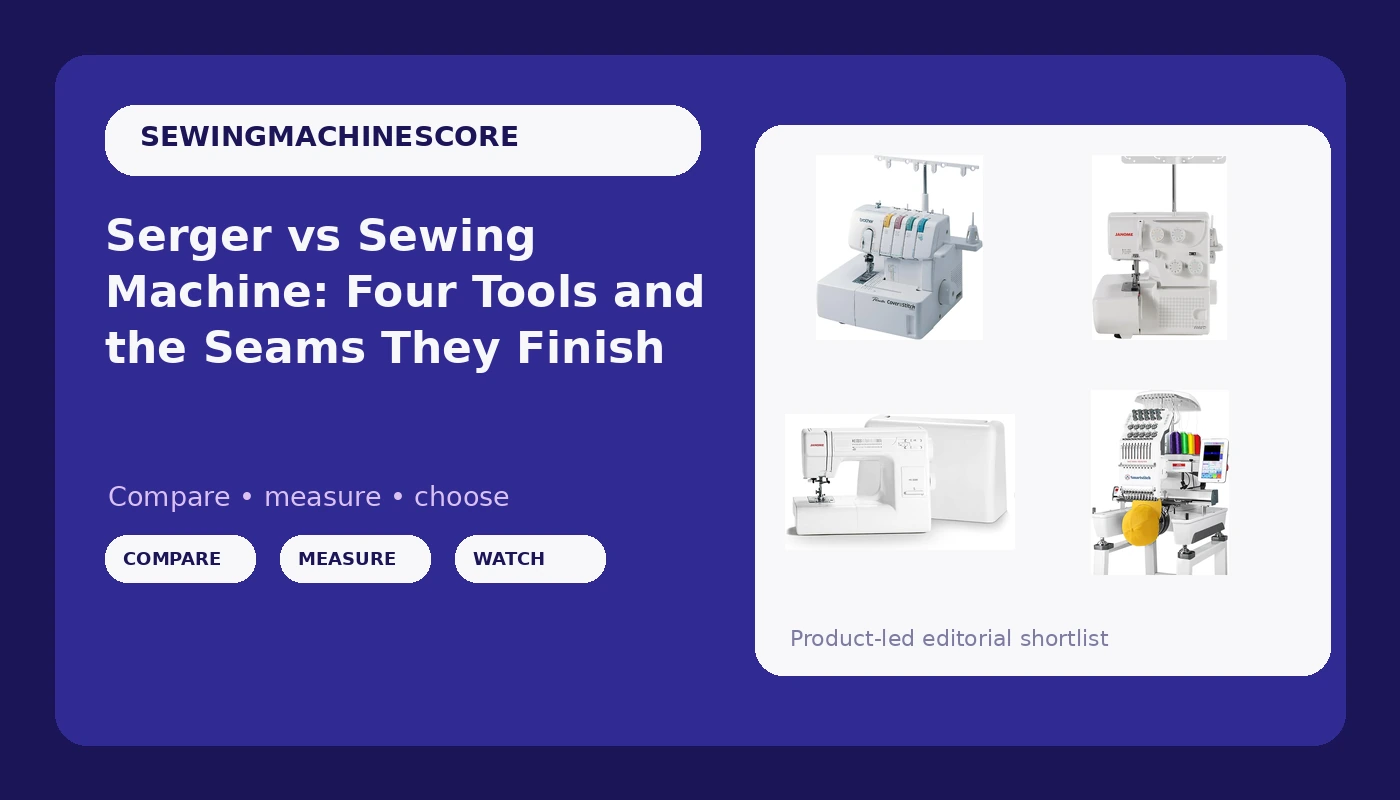
Buying a machine for a home sewing room goes wrong in a predictable way. Someone decides they need "the best sewing machine," buys one, and later discovers that the seam they actually care about, a stretchy hem on a knit dress or a finished edge inside an unlined jacket, is not a seam a standard sewing machine makes well. The serger vs sewing machine question is usually the wrong question. A serger and a sewing machine are not rivals competing for the same slot on the table. They are different tools that solve different problems, and plenty of garment sewers eventually want both.
This guide sorts four machines into the four jobs they do: a mechanical heavy-duty sewing machine, a 3/4 thread overlock serger, a coverstitch machine, and a multi-needle embroidery machine. Which one belongs in your room depends on the fabric you actually sew and on how you want the inside of the garment to look when it is finished. That is a much more useful question than which machine wins.
Related: How to Choose Your First Serger Without Overbuying →
Quick answer
Start with a sewing machine if you are building a sewing room from nothing, because every other tool here supports seams that a sewing machine begins. Add an overlock serger when you sew knits, or when you are tired of pinking shears and fraying seam allowances. Add a coverstitch machine when you hem knits and want the folded, parallel-row finish that an overlock cannot produce. Choose the embroidery machine when decoration is the point of the project and the flat, hat, and t-shirt formats on your list match the work you do.
Four useful options
| Model | Best fit | What stands out |
|---|---|---|
| Janome HD3000 Heavy-Duty Sewing Machine with 18 Built-in Stitches + Hard Case | Everyday woven garment sewing and classes | 18 built-in stitches, heavy-duty mechanical build, hard case included |
| Janome 8002D Overlock Machine - 3/4 Thread Serger Sewing Machine with Differential Feed System for Extra-Smooth Seams, Janome Serger with 1300 Stitches Per Minute and Easy Threading | Knit seams and raw edge finishing | Switchable 3/4 thread setup, differential feed, 1300 stitches per minute |
| Brother 2340CV Coverstitch Serger Sewing Machine | Hemming knits and folded edges | Coverstitch format built for hem and fold finishing |
| Smartstitch S-1001 Upgraded Embroidery Machine with 10 Needles, 1200SPM Max Speed, 7" Touch Screen, 9.5"x14.2" Embroidery Area, New Gen of Commercial Embroidery Machine for Flat, Hat, T-shirt and more | Flat, hat, and t-shirt embroidery | 10 needles, 1200 SPM max speed, 7 inch touch screen, 9.5 by 14.2 inch area |
The everyday machine: Janome HD3000 Heavy-Duty Sewing Machine with 18 Built-in Stitches + Hard Case
The trade-off with a machine like this is arithmetic rather than mystery. Eighteen stitches is a small number next to the hundred-stitch counts printed on some boxes, and if you have ever counted how many of those stitches you actually use, you already know that a decorative stitch library is mostly a marketing number. What the HD3000 offers instead is a mechanical machine with fewer circuit boards to fail, which matters because a computerized machine that loses its board can cost a large fraction of its purchase price to repair. The honest limitation is that a mechanical machine will not do automatic needle threading, it will not do stitch memory, and it will not embroider. If those features are the reason you are shopping, this is the wrong category for you.
The seam finisher: Janome 8002D Overlock Machine - 3/4 Thread Serger Sewing Machine with Differential Feed System for Extra-Smooth Seams, Janome Serger with 1300 Stitches Per Minute and Easy Threading
Differential feed is the feature worth understanding before you buy any serger, because it is the difference between a wavy knit seam and a flat one. The feed dogs move the fabric at slightly different rates on the two plates, so you can set the machine to stretch a knit as it feeds (preventing the seam from popping when the fabric relaxes) or to gather it slightly. On a woven fabric, the same adjustment prevents the puckered, overstretched edge that a straight-feed serger produces. The 3/4 thread choice matters too: 4-thread overlock is the stronger, bulkier construction seam, while 3-thread is lighter and better for finishing edges on fabric that does not need a full seam. A serger like this does not replace your sewing machine. It cannot make a buttonhole, it cannot insert a zipper, and it does not lock a seam with a backstitch. It finishes what the sewing machine starts.
The hem maker: Brother 2340CV Coverstitch Serger Sewing Machine
This is the machine people buy last and appreciate most, and it is also the one most often bought by mistake. A coverstitch is not a better serger. It is a different machine that stitches a fold, which is why the hem of a store-bought t-shirt has those two parallel lines on the outside and a soft, loopy finish on the inside. If you sew a lot of knit garments, the sequence is overlock the raw edges, then coverstitch the hem, and the coverstitch is what makes the result look bought rather than homemade. The limitation is narrowness: a coverstitch machine is close to useless on woven garment construction, it will not finish a raw edge on its own, and it does not replace the overlock. Buying one before you own an overlock usually means you bought the second tool first.
The embellishment machine: Smartstitch S-1001 Upgraded Embroidery Machine with 10 Needles, 1200SPM Max Speed, 7" Touch Screen, 9.5"x14.2" Embroidery Area, New Gen of Commercial Embroidery Machine for Flat, Hat, T-shirt and more
Ten needles is the detail that separates this class of machine from a single-needle home embroidery unit. On a single-needle machine, every color change means stopping, rethreading, and restarting, which is fine for a monogram and miserable for a six-color logo on twenty shirts. The trade-off is scope. This machine embeds designs; it does not construct garments, it does not finish seams, and it does not sew a hem. It also occupies a very different price tier from the three machines above, so it belongs in the plan only if embroidery is a service you sell or a craft you have already committed to. The 9.5 by 14.2 inch area is generous for a home setup and constraining for anyone used to a full commercial frame.
Prices and availability may change. Product images, names, and retailer links must be matched by verified ASIN. Do not state a current price, rating, stock status, or measured result without current evidence.
What a serger does that a sewing machine cannot
A sewing machine makes a lockstitch. Two threads meet in the middle of the fabric and lock, which is why the stitch holds and why it comes apart so neatly when you pull the bobbin thread to frog a seam. A serger makes an overlock, which is a different structure entirely: loopers carry threads around the raw edge of the fabric while a blade trims that edge, so the machine sews and finishes in a single pass. That is why a serged seam allowance looks clean on the inside of a garment without any further work.
The practical consequences of that difference are worth spelling out. A serger cannot backstitch, so seams are secured by chaining off or by tucking the thread tail. A serger cannot make a buttonhole, which is the single most revealing test of any machine's brain. A serger cannot insert a zipper or topstitch a fold. What it can do is turn a stack of cut pieces into something that looks finished inside, and it does that at a speed that makes a sewing machine feel slow by comparison. If you sew knits, the overlock is also what keeps a seam from cracking when the fabric stretches.
Overlock and coverstitch are two different jobs
These two get lumped together constantly, and the confusion costs people money. An overlock wraps the raw edge of a single layer or a seam allowance. A coverstitch folds the fabric and stitches across the fold, producing parallel lines on the face and a loopy, stretchable finish on the back. The overlock finishes an edge; the coverstitch finishes a hem.
That means the order of purchase matters. If you sew knit garments and own only a sewing machine, the overlock comes first, because most of your seams need edge finishing. The coverstitch comes second, when you are tired of hemming knits with a twin needle and a stretch stitch that still pops. Buy them in the other order and you will own a machine that can hem a dress you cannot yet sew well.
- Sort your last five projects by fabric and count how many were knits, because knit construction is what justifies a serger.
- Count the seams that fray or that you currently finish with pinking shears, since that number is the honest case for an overlock.
- Turn a favorite knit garment inside out and look at the hem, because that is the coverstitch finish and it is either worth the money to you or it is not.
- Decide whether decoration is the product you sell or a hobby inside the hobby, since embroidery only pays for itself when it is the point.
- Match the machine to the space and the power you actually have, because a multi-needle machine needs a footprint and a dedicated table that a mechanical sewing machine does not.
Practical guidance before you buy
- Keep a seam journal. Five fabric types, three stitch lengths, and a verdict per machine turns a vague feeling about a machine into a record you can compare later.
- Buy for the fabric you actually sew, not the fabric you intend to sew. A quilting setup frustrates a garment sewer and the reverse is just as true.
- Budget for thread as a separate line item. Overlock and coverstitch machines use cones rather than spools, and the thread cost is real.
- Learn to thread the machine from scratch before you rely on an automatic threader, because threaders break and the machine is not broken when they do.
- Check that the feet and accessories you need exist for the specific model, since presser feet and attachments are where the long-term cost of a machine hides.
Which option should you choose?
Choose the Janome HD3000 Heavy-Duty Sewing Machine with 18 Built-in Stitches + Hard Case when you are building a sewing room from nothing or replacing a machine that cannot handle thicker fabric, because it is the tool that makes every other seam possible. Choose the Janome 8002D Overlock Machine - 3/4 Thread Serger Sewing Machine with Differential Feed System for Extra-Smooth Seams, Janome Serger with 1300 Stitches Per Minute and Easy Threading when you sew knits regularly or want raw edges finished without pinking shears. Choose the Brother 2340CV Coverstitch Serger Sewing Machine when you already own an overlock and the hems on your knit garments are the thing that makes them look homemade. Choose the Smartstitch S-1001 Upgraded Embroidery Machine with 10 Needles, 1200SPM Max Speed, 7" Touch Screen, 9.5"x14.2" Embroidery Area, New Gen of Commercial Embroidery Machine for Flat, Hat, T-shirt and more when embroidery is the work itself rather than a detail on top of it.
One caveat applies to all four. Manufacturer listings and specifications change, features get revised between production runs, and a name that carried one set of specs last year can carry a slightly different set this year. Verify the current listing details, the included accessories, and the warranty terms on the product page before you commit, and treat any speed or stitch figure as a manufacturer claim rather than a measured result.
The bottom line
The serger vs sewing machine question dissolves once you stop treating the machines as competitors. A sewing machine builds the garment, an overlock finishes its edges, a coverstitch finishes its hems, and an embroidery machine decorates it. Rank those four jobs by how often you do them, and the machine at the top of that list is the one to buy next. For most people starting out, that is a solid mechanical sewing machine, and the rest of the room gets built one seam type at a time.