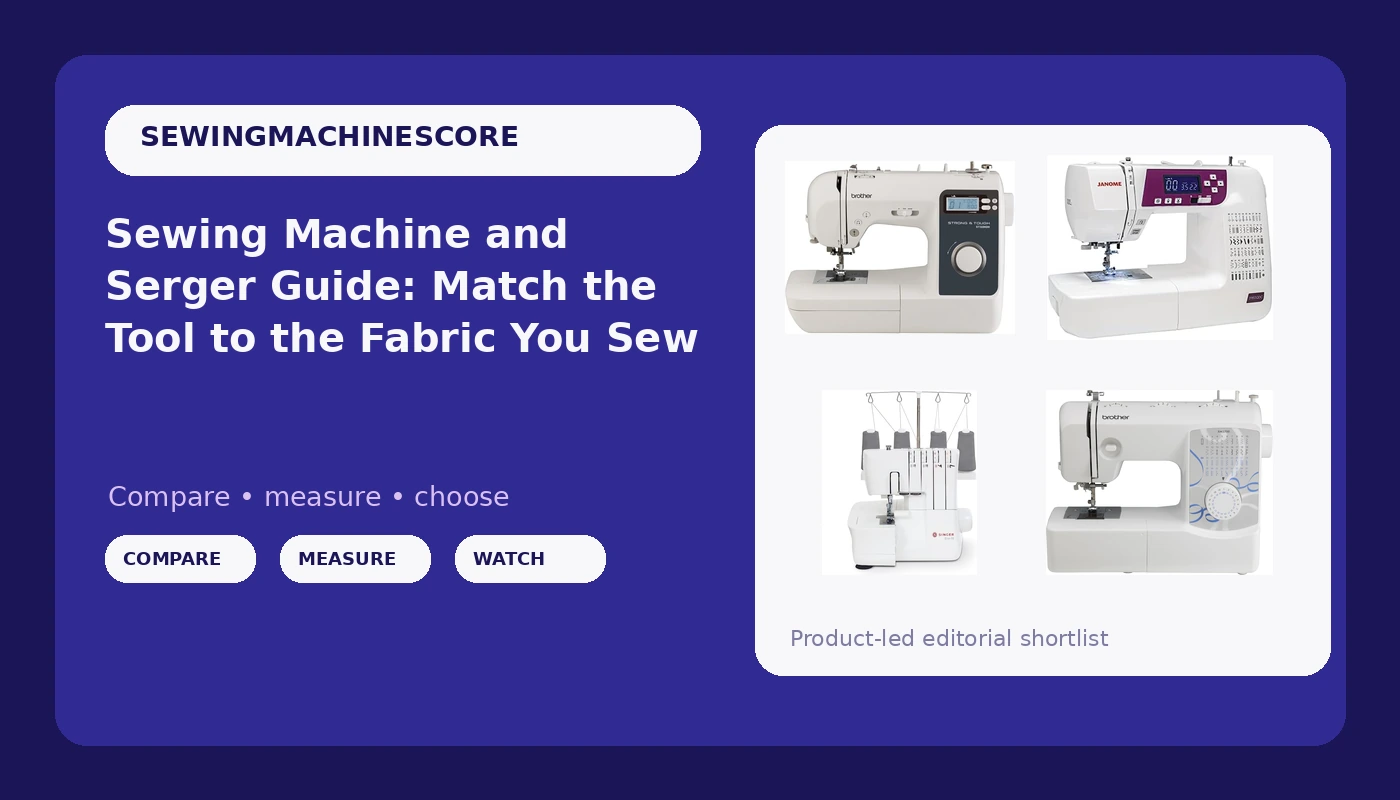
Most people shopping for a first or second machine get stuck on the same question: which of these boxes actually does the work I do? The listings do not help much, because they all advertise stitch counts, accessory feet, and a photograph of the machine beside a potted plant. What they rarely answer is whether the thing will feed a stack of denim without complaining, whether the tension holds across a curved seam, or whether the tool you actually need is a serger rather than a sewing machine at all. This sewing machine and serger guide covers four verified models: two Brother sewing machines, a Janome quilting machine, and a Singer overlock. It is an explainer, not a ranking, because the right answer depends almost entirely on the fabric you actually sew.
Related: How to Test a Sewing Machine Before You Buy →
Quick answer
Start with the job, not the machine. If you sew garments and want one tool that covers the most ground, a full-size sewing machine with a dependable straight stitch and a usable buttonhole is the right place to begin. If you quilt, a machine sold specifically as a quilting machine will match the work better than a general-purpose model. If your recurring problem is fraying seam allowances and raw edges, you want an overlock serger, and no sewing machine replaces that function. The four models below cover those three jobs, and the table below states what each one is positioned for rather than pretending one of them wins everything.
Four useful options
| Model | Best fit | What stands out |
|---|---|---|
| Brother ST150HDH Strong and Tough Sewing Machine 50 Stitches | Sewing thick, layered, and stubborn fabric | 50 built-in stitches and Brother's Strong and Tough positioning |
| Janome 3160QDC-G Sewing and Quilting Machine with Bonus Quilt Kit! | Quilting plus everyday garment sewing | Sold as a sewing and quilting machine and bundled with a quilt kit |
| SINGER® S14-78 Serger Overlock Machine, 2-3-4 Stitch Capability, White | Finishing edges and seam allowances | 2-3-4 stitch capability in an overlock format |
| Brother XM3700 Sewing Machine 37 Built-in Stitches | A first machine for a new sewer | 37 built-in stitches in a full-size Brother body |
The thick-fabric machine: Brother ST150HDH Strong and Tough Sewing Machine 50 Stitches
The trade-off here is straightforward. A machine positioned for thick fabric is a machine you buy when your sewing involves canvas, denim, layered costume pieces, or upholstery-weight material. If most of your work is quilting cotton and lining fabric, you are paying for capability you will not exercise, and a quilting-oriented machine will suit you better. It is also worth being clear about what the "heavy duty" language in this category can and cannot promise. Stitch count and a marketing name do not tell you how the machine will behave on a specific stack of fabric. The only honest way to know is to test the straight stitch on several fabric types, which is exactly the test this site applies before forming a verdict on anything.
The quilting machine: Janome 3160QDC-G Sewing and Quilting Machine with Bonus Quilt Kit!
Quilting machines and garment machines overlap more than people expect, but they are not identical. A quilting-focused machine tends to be set up around piecing accuracy, a good straight stitch, and the accessories that help you move a quilt sandwich, which is why the quilt kit in this bundle matters more than it looks. For garment sewing, the same machine will handle seams and hems comfortably. Where it may not be the obvious pick is if your sewing is dominated by thick, layered, or heavy fabric, because that is the job the Brother above is explicitly positioned for. Buy for the fabric you actually sew, not for the fabric you imagine sewing someday.
The finishing tool: SINGER® S14-78 Serger Overlock Machine, 2-3-4 Stitch Capability, White
There is a persistent argument in sewing communities about whether a serger is worth owning, and most of it is wasted energy, because a serger and a sewing machine are different tools doing different jobs. A sewing machine builds the seam. A serger trims, wraps, and finishes the edge, and it does it fast. If you sew knits, or you sew garments you intend to wear and wash repeatedly, a serger changes how professional the inside of the garment looks. What it will not do is replace your sewing machine, so treat this as an addition to a setup rather than a substitute for one.
The first machine: Brother XM3700 Sewing Machine 37 Built-in Stitches
A first machine has one real specification: it should make you want to sit down and sew again tomorrow. Everything else is secondary. The 37-stitch Brother fits that brief because it is a full-size machine with ordinary controls and no exotic requirements. The honest limitation is headroom. If you already know you are going to spend the next two years on quilting or on heavy layered work, the machine you start with will become the machine you outgrow, and you may prefer to buy once. If you are genuinely new and unsure what you will love, starting here and upgrading later is a defensible plan.
Prices and availability may change. Product images, names, and retailer links must be matched by verified ASIN. Do not state a current price, rating, stock status, or measured result without current evidence.
What a sewing machine and a serger actually do
A sewing machine makes a lockstitch. An upper thread and a bobbin thread interlock in the fabric, and that single mechanism is behind every straight seam, zigzag, and decorative stitch the machine offers. When people say a machine has a good straight stitch, they mean the stitch forms cleanly, the thread sits in the fabric instead of looping on top, and the seam does not pucker as it feeds. That quality is the foundation, and everything else, including the stitch count, is convenience layered on top of it.
A serger works on an entirely different principle. It uses multiple threads, and it wraps them around the edge of the fabric while a blade trims the edge clean. That is why a serged seam allowance looks finished and does not fray. It is also why a serger is fast and why it cannot do the job of a sewing machine: it is built to finish edges, not to join two pieces with a straight seam in the middle of a garment.
Two other terms are worth knowing before you compare listings. Tension is the setting that balances the upper and lower threads, and it is the dial most people touch without understanding. If the tension is wrong, the machine looks broken when it is not. The bobbin is the lower thread supply, and bobbin problems account for a large share of the "my machine is broken" posts in any sewing forum. Neither issue is a reason to replace a machine. Both are reasons to learn the machine you already have.
How to read a machine listing before you buy
Stitch count is the most advertised number and the least useful one. A machine with 100 stitches may realistically use ten of them, and the straight stitch quality is not improved by the other ninety. Read the listing for the things that actually change your daily experience: what fabric weight the machine is positioned for, whether it is sold as a quilting machine or a general-purpose one, whether a serger function is included, and whether the bundle includes accessories you would otherwise buy separately, such as the quilt kit in the Janome listing.
A short method for narrowing four machines down to one:
- Write down the three fabrics you sewed most in the past year. Be honest, not aspirational.
- Decide whether your recurring frustration is seam quality or edge finishing. Seam quality points to a sewing machine; edge finishing points to a serger.
- Check whether you need the machine to handle thick layers. If yes, the heavy-fabric model moves to the front.
- Look at the included accessories, since a bundle can cover items you would buy anyway.
- Test the straight stitch on at least three fabric types before you commit, and check the buttonhole, because buttonholes reveal more about a machine than its stitch count does.
Matching the machine to your fabric and your habits
- If you sew costumes, bags, or anything with multiple thick layers, weight the heavy-fabric capability above stitch variety.
- If you piece quilts, a machine sold as a quilting machine plus a quilt kit will fit your routine better than a general-purpose model.
- If you sew knits or washable garments and hate fraying seam allowances, budget for a serger as a second tool rather than expecting one machine to do both jobs.
- If you are brand new, pick the simplest full-size machine that covers straight seams and a basic buttonhole, and spend the saved money on fabric to practice on.
- Whichever machine you choose, keep a note of the fabric, stitch length, and result for each project. A written record teaches you more about tension than any manual.
Which option should you choose?
Choose the Brother ST150HDH Strong and Tough Sewing Machine 50 Stitches when your sewing regularly involves thick, layered, or heavy fabric and you want the extra stitch options that come with it. Choose the Janome 3160QDC-G Sewing and Quilting Machine with Bonus Quilt Kit! when you quilt, or when you want one machine that handles piecing and everyday garment seams with a quilt kit included. Choose the SINGER® S14-78 Serger Overlock Machine, 2-3-4 Stitch Capability, White when your problem is fraying edges and unfinished seam allowances, and you are adding a second tool rather than replacing your sewing machine. Choose the Brother XM3700 Sewing Machine 37 Built-in Stitches when you are starting out, want a full-size machine with a manageable number of stitches, and would rather learn on something straightforward before committing to a specialty.
One caveat applies to all four. The information here comes from the product listings and manufacturer positioning, not from a controlled test of these specific units. Stitch quality, tension behavior on thick fabric, and buttonhole results vary by machine and by how it is set up, so treat the descriptions above as a map of what each model is for, and verify the details that matter most to you before buying.
The bottom line
These four machines are not competing for a single title. The Brother ST150HDH is the pick when fabric weight is your obstacle. The Janome 3160QDC-G is the pick when quilting and general sewing share your table. The Singer S14-78 is the pick when the job is finishing edges, which no sewing machine in this group does. The Brother XM3700 is the pick when you are new and want a full-size machine with 37 stitches to learn on. Read your own fabric habits honestly, decide whether you need a sewing machine, a quilting machine, or a serger, and the choice usually makes itself. Check current Amazon price on the model that matches the work you actually do, not the work you hope to do.