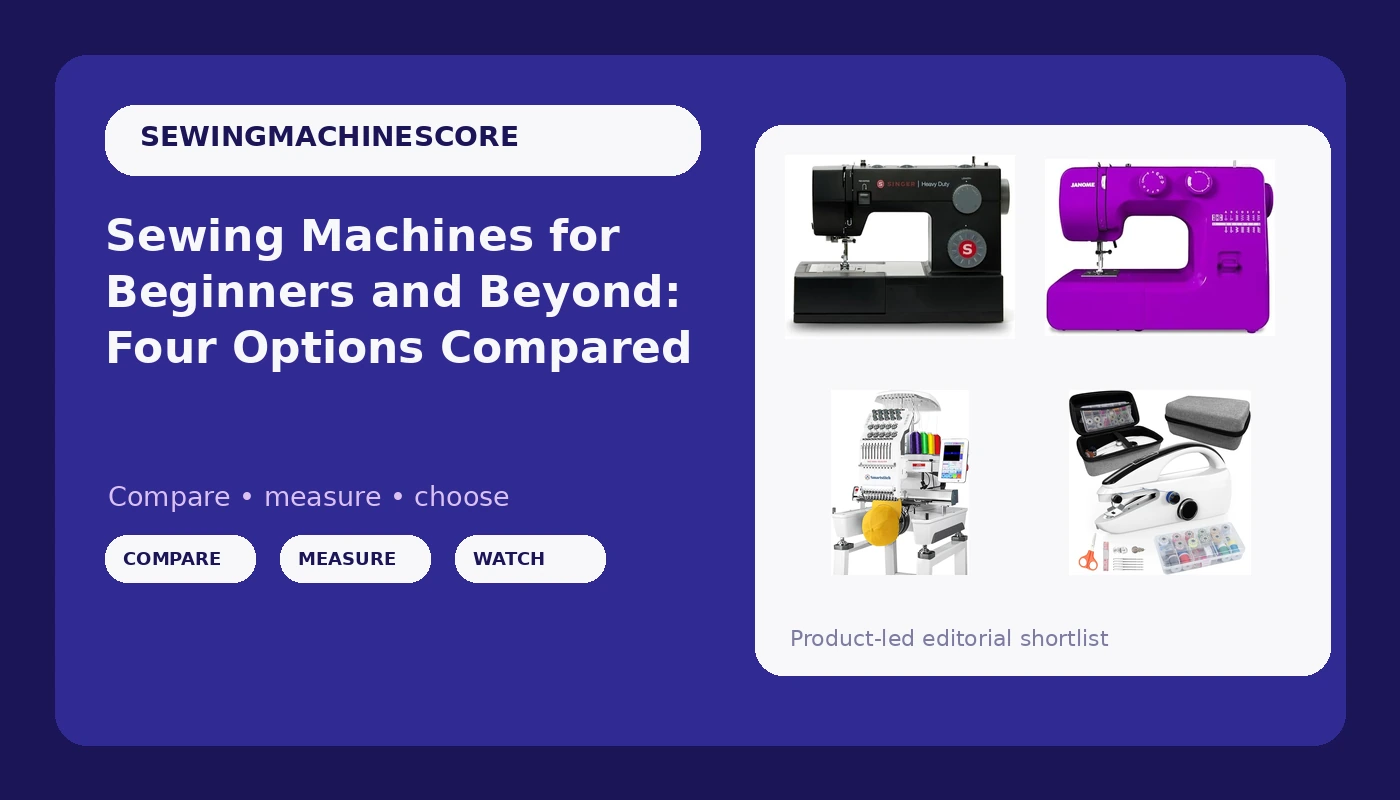
Shopping for sewing machines for beginners is not really a search problem. There are plenty of machines. It is a matching problem. The machine that feels wonderful on quilting cotton can feel completely wrong the first time you feed it a stack of denim, and a production embroidery machine will not hem a pair of trousers no matter how much you paid for it. Most of the frustration I see in beginner classes comes from someone buying for a machine's reputation instead of for the fabric and the task in front of them.
This is an explainer, not a ranking. It walks through four very different machines, what each one is actually built to do, and the spec-sheet language worth translating before you spend money.
Related: Best Beginner Sewing Machines for Garment Sewing →
Quick answer
There is no single best sewing machine, because the right answer depends on the job. If you sew garments and light quilting and want a forgiving first machine, the Janome Purple Majesty is the one explicitly built with beginners in mind. If you sew heavier fabric and want more speed, the SINGER 4432 pairs a high speed heavy duty label with an accessory kit. If your goal is embroidery on flat goods, hats, or shirts, the Smartstitch S-1001 is a ten-needle commercial style machine. And if you only need to reattach a hem or a button without setting up a full machine, the handheld Sewing Kit covers that. Buy for the fabric and the task, not for the stitch count.
4 useful options
| Model | Best fit | What stands out |
|---|---|---|
| Janome Purple Majesty | A first machine for garments, patchwork, and light quilting | Interior metal frame, bobbin diagram, tutorial videos |
| SINGER 4432 (Black) | Heavier fabric and longer seams at higher speed | High speed heavy duty build plus an accessory kit |
| Smartstitch S-1001 | Flat, hat, and T-shirt embroidery | 10 needles, 1200 SPM max speed, 7-inch touch screen, 9.5 x 14.2 inch area |
| Sewing Kit: Sewing Bliss in One Box | Quick repairs, travel, and portable mending | A handheld sewing machine packaged as a single kit |
Beginner-friendly garment machine: Janome Purple Majesty Easy-to-Use Sewing Machine
The interior metal frame is the detail I would point a beginner toward first, because it is the least glamorous and the most consequential. A rigid chassis absorbs vibration instead of amplifying it, and vibration is what turns a clean seam into a wobbly one at speed. The bobbin diagram and tutorial videos matter more than they sound, too. Bobbin issues sit behind a huge share of the "my machine is broken" posts I see, and a machine that teaches you its own threading path removes an entire category of early frustration.
The trade-off is in the wording of the product description itself: garments, patchwork, and light quilting. That "light" is doing real work. If your plan is to quilt a king-size bed quilt with dense stitching, this is not the machine for that job, and no amount of patience will change it. For a first machine focused on clothes, it lines up well.
Higher speed heavy duty option: SINGER® 4432 (Black) High Speed Heavy Duty Sewing Machine + Accessory Kit
"Heavy duty" is a marketing phrase, and it is worth being honest about that. On a modern consumer machine it usually signals a higher speed rating, a stronger motor spec, and a claim about penetrating thicker fabric, not an industrial build. What actually determines whether a machine handles a heavy seam is the frame, the feed system, and the needle you chose, in roughly that order. Put a sharp needle suited to the fabric in any machine and it will do better than a dull universal needle in an expensive one.
The bundled accessory kit is the practical upside here. Feet, bobbins, and needles add up fast when you buy them separately, and having them in the box means you can start on real projects rather than on a shopping list. If your sewing skews toward bags, home decor, canvas, or denim, and you want more speed for long straight seams, this is the more natural fit of the two conventional machines here.
Production embroidery: Smartstitch S-1001 Upgraded Embroidery Machine
Ten needles is the number that tells you what this machine is. On a single-needle embroidery machine, every color change means stopping, pulling the old thread, rethreading, and restarting. Ten needles means ten colors sit threaded and ready, and the machine moves to the next one on its own. That is a workflow decision, not a decoration, and it is the difference between finishing a multi-color design in one sitting and abandoning it in a drawer.
The 9.5 by 14.2 inch area and 7-inch touch screen round out the picture of a machine aimed at repeat work on flat goods, hats, and shirts. Be clear about the boundary: this embroiders, it does not construct garments. It will not sew a seam, set a sleeve, or install a zipper. If you want to embroider a logo on a jacket you already made, this is the tool for the decoration step. If you want to make the jacket, it is not. There is also a real learning curve around design files and hooping that has nothing to do with the hardware.
Handheld mending: Sewing Kit: Sewing Bliss in One Box. Handheld Sewing Machine
Every costume shop I have worked in has a version of this in a drawer, and it earns its place. A handheld machine is a mending tool: a fallen hem, a popped seam on a backpack strap, a quick tack before a curtain goes up. It lives in a bag, needs no table, and takes seconds to deploy. For a school production with forty kids in rotation, that speed is the whole value.
The trade-off is honest and worth stating plainly. A handheld machine is not a substitute for a full-size sewing machine, and it will not give you the stitch control or the fabric handling you need for construction work. Buy it as a supplement to a real machine, or as a starter for someone who only ever mends. Do not buy it as your only machine if you intend to make clothes.
Prices and availability may change. Product images, names, and retailer links must be matched by verified ASIN. Do not state a current price, rating, stock status, or measured result without current evidence.
What actually decides stitch quality
Ask a hundred sewists what makes a machine good and you will get a hundred answers about stitch count. The honest answer is duller and more useful: balanced tension, a stable chassis, and a feed system that moves fabric predictably.
Tension is the dial everyone touches and nobody understands. It controls how the upper thread and the lower thread meet inside the fabric. Set correctly, the knot sits buried in the middle of the fabric and both sides of the seam look identical. Set wrong, you get loops underneath, and no amount of rethreading the top will fix a bobbin case that has been threaded incorrectly. Before you blame any machine, rethread the bobbin.
Chassis rigidity comes second. This is why an interior metal frame shows up in product descriptions, and why it is worth paying attention to. A frame that resists flex keeps the needle aligned and the feed consistent. Vibration is the enemy of a straight seam, and frames are how manufacturers fight vibration.
Third is the feed system and presser foot pressure. Feed dogs pull the fabric from below, the presser foot holds it from above, and the balance between them determines whether two layers of slippery fabric stay aligned. On thick seams, a walking foot accessory changes the equation entirely by moving the top layer with the bottom. It is the single most useful accessory in sewing, and it is not a beginner crutch.
Reading a sewing machine spec sheet
Manufacturers list what is easy to measure, which is not always what matters. Here is how to translate the numbers.
Speed ratings like 1200 SPM describe the maximum stitch rate. Real sewing happens well below the ceiling, especially around curves and corners. A higher rating is useful for long straight seams and production work, and largely irrelevant for a hobbyist making a dress.
Stitch counts are the most oversold spec on any box. A machine with 100 stitches typically uses around ten of them regularly: straight, zigzag, a few stretch stitches, and a buttonhole. Count the stitches you recognize, not the total.
Embroidery needle counts are the exception, because they are a workflow spec rather than a variety spec. Ten needles means ten threaded colors, and that genuinely changes how you work.
Hoop or embroidery area determines the largest design you can stitch in one pass without repositioning. It is the embroidery equivalent of throat space.
Accessory kits are the quiet value in a bundle. Feet, bobbins, and needles are the things you will actually buy in month one, so their presence in the box is worth more than a couple of extra decorative stitches.
Here is the sequence I would walk a beginner through before they buy:
- Write down the last three things you actually sewed or wanted to sew.
- Name the fabric for each of those projects. Denim and canvas point one direction, cotton lawn and knits point another.
- Decide whether you need embroidery at all, because that is a separate machine category, not a feature.
- Check the accessory list against your project list. A walking foot, a zipper foot, and a buttonhole foot cover most garment work.
- Ask what happens when a part fails: are feet, bobbins, and needles easy to find for that brand and model?
Practical guidance before you buy
- Set a realistic budget that includes thread, needles, bobbins, and at least one specialty foot, not just the machine.
- Buy for the fabric you sew most, not the fabric you imagine sewing someday.
- Prioritize a machine you can thread confidently. A machine you avoid using is a machine you wasted money on.
- If you plan to quilt anything larger than a throw, check the throat space and consider a machine positioned for quilting specifically.
- Treat "heavy duty" as a claim to verify against the frame and the motor, not as a guarantee stamped on a plastic body.
- Keep a seam test journal. Five fabric types, a few stitch lengths, and a verdict per machine teaches you more than any spec sheet.
Which option should you choose?
Choose the Janome Purple Majesty Easy-to-Use Sewing Machine when you are starting out and your projects are garments, patchwork, and light quilting, and you want setup guidance built into the machine. Choose the SINGER® 4432 (Black) High Speed Heavy Duty Sewing Machine + Accessory Kit when you sew heavier fabric, want more speed for long seams, and value having the accessory kit included from day one. Choose the Smartstitch S-1001 Upgraded Embroidery Machine when your goal is multi-color embroidery on flat goods, hats, and shirts, and you understand that it decorates rather than constructs. Choose the Sewing Kit: Sewing Bliss in One Box. Handheld Sewing Machine. when you need portable mending, a costume shop backup, or a supplement to a machine you already own.
One caveat on all four: the descriptions above come from the manufacturers' own product listings, not from a seam test on my table. I do not label a machine the quietest, the strongest, or the best unless I have run it across multiple fabric types myself, and these listings do not support that kind of verdict. Use the specs and the stated use cases as a starting filter, then read current owner feedback and, if you can, try the machine in person.
The bottom line
Match the machine to the fabric and the task, and almost every other decision gets easier. A beginner sewing garments gets more value from a forgiving, well-guided machine than from a high stitch count. Someone sewing canvas and denim should look at speed and build rather than decorative stitches. Embroidery is its own craft with its own hardware, and a ten-needle machine is a workflow tool for people who already know they need one. And a handheld kit is a mending companion, not a workshop. Decide what you actually sew, then buy for that, and check current Amazon price on the model that fits before you commit.