Related: How to Thread a Serger: The Order That Actually Works
Serger shopping goes sideways in the same three places every time. Someone buys a machine with too few thread options and outgrows it in a month. Someone buys a machine they are afraid to thread, so it lives under a cover while they sew on their regular machine. Someone buys a serger when what they actually wanted was a better straight stitch. I have taught beginner sewing classes in Portland for years, sewn costumes for a school of 400 kids, and ripped out enough bad seams to recognize all three mistakes on sight. So when a student asks me about a Singer overlock serger, my first question is never about price. It is about fabric.
A serger is not a sewing machine, and it is not a replacement for one. It trims the edge, wraps it in thread, and finishes it, which is why a serged seam on a stretch knit looks like something that came off a store rack. It will not give you a straight stitch, it will not give you a buttonhole, and it will not do the structural work of a seam. They are different tools, and I review them separately.
This guide covers the two Singer sergers I would put on a shortlist for a hobbyist, plus two small items that solve problems both sergers and sewing machines create: a handheld mending machine and a needle threader.
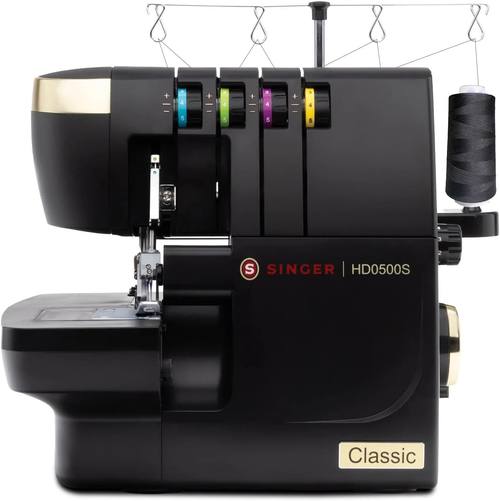
Best Overall: SINGER HD0500S Heavy Duty Serger Overlock Machine
If you are buying one serger and you want it to cover the most ground, start here. The thread count is the reason. This machine lists 2-3-4 thread capability, which means three setups in one box: a two-thread rolled hem for a ruffle or a lightweight costume edge, a three-thread overlock for finishing a seam allowance so it stops fraying, and a four-thread seam for knits that actually have to stretch and hold.
That flexibility matters more than any other line on a serger spec sheet, and it is the first thing I check. A machine that only does three threads will finish your seam allowances and do nothing else. A machine that does two, three, and four threads lets you build the whole costume, hem included.
The HD badge is also worth something to me. I have been hard on modern Singer machines and I stand by that. The vintage ones were built differently, and a plastic body with a heavy duty sticker on it is one of my least favorite things in this hobby. The HD series is the exception I make. It is the part of the current lineup I would hand a student, and this is the HD serger.
It comes in black, which is a practical choice for a machine that lives out on a dining table and gets wiped down twice a week.
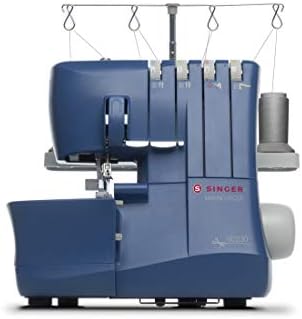
Best Value: SINGER S0230 Navy Blue High Speed Overlock Serger
The second Singer serger here carries the same 2-3-4 thread capability, and that is the whole comparison in one line. On the spec sheet, the thread options tie, and thread options are what I care about most. Two-thread rolled hems, three-thread finishing, four-thread seams. You get all three setups here too.
Where this one is positioned differently is speed. The name says high speed, and speed is not a vanity spec on a serger. When you are finishing long seam allowances on a full skirt or closing the side seams of a stack of kids' costumes, the machine's pace decides whether you finish tonight or next weekend. If most of your sewing is short, fiddly work, a faster machine will not change your life. If you sew yardage, it will.
The navy finish is a small thing and I will mention it anyway: this is the machine in the pair that looks like something other than shop equipment.
If you are a beginner who wants one serger, this is the one I would tell you to look at first, with one condition. You have to be willing to learn the thread path. More on that below.
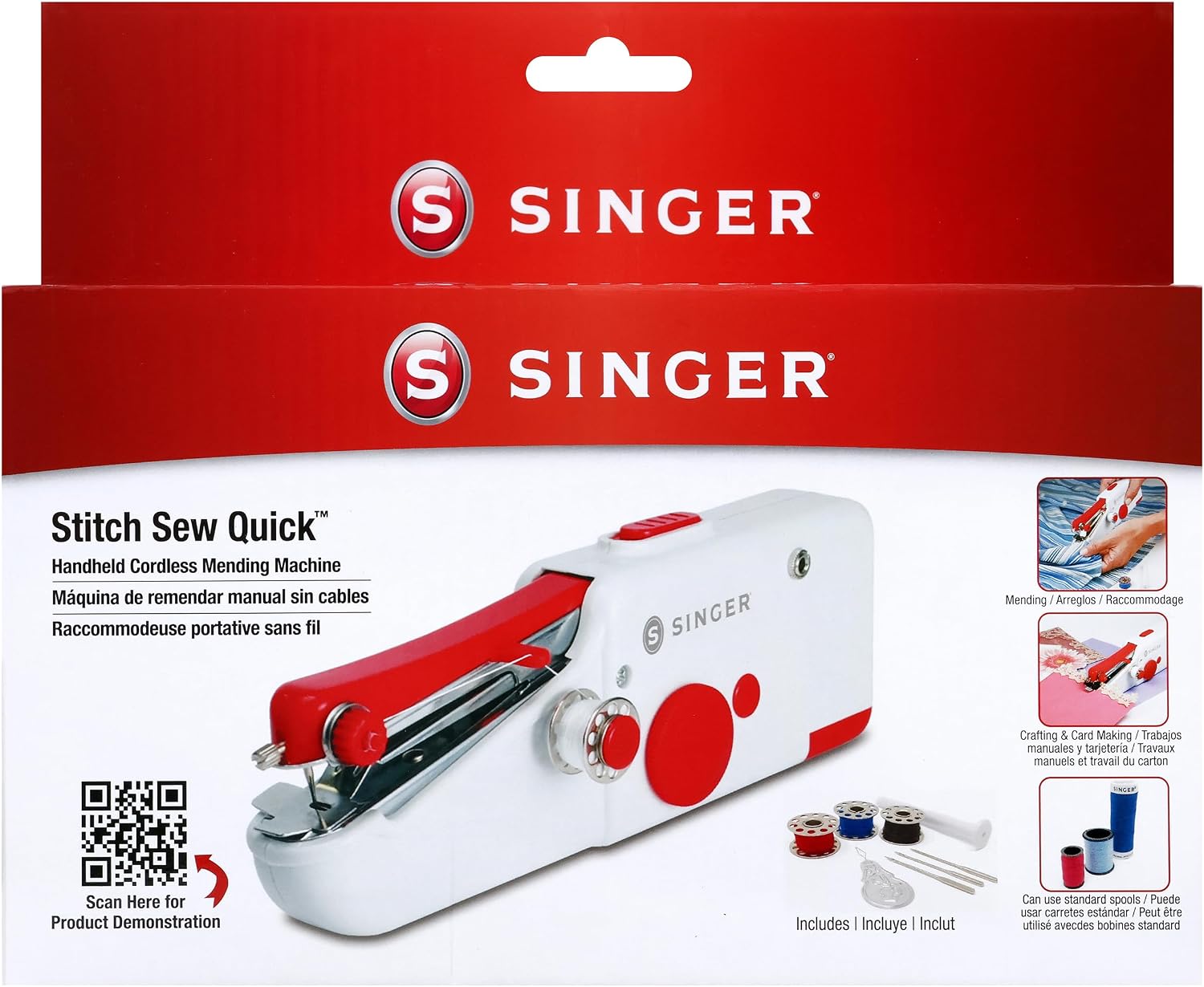
The handheld mending machine: SINGER Stitch Sew Quick Portable Handheld Cordless Mending Machine
This is not a sewing machine and it is not trying to be. It is a cordless handheld mender, and the job it does is the job that shows up at the worst possible time: a hem that let go ten minutes before a recital, a costume strap that needs to be tacked back down, a kid's seam that opened between the car and the school gym.
I keep a handheld machine in my bag for exactly that reason. In the costume shop, the panic repairs never happen at the table where the good machines live. They happen in a hallway, on a riser, or in a parking lot.
What it will not do is build a garment. Handheld machines are for mending weight, not construction weight, and I would not ask one to replace a straight stitch on a fitted bodice. Buy it as the tool that saves an evening, not the tool that sews your project.
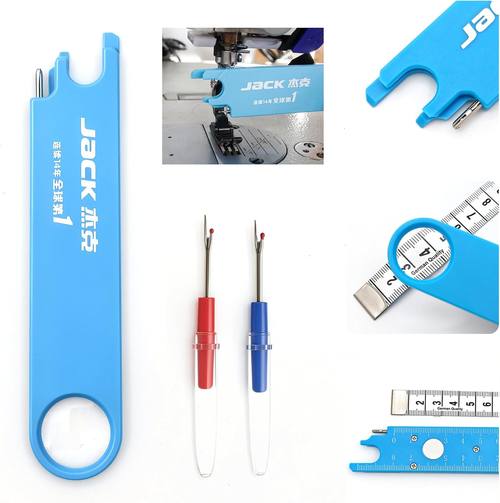
The small accessory: Jack Quick Needle Threader for Sewing Machine, 3-in-1 Sewing Supplies
Automatic needle threaders break. That is not a knock on any one brand. It is what happens when a tiny mechanical hook lives inside a machine that vibrates for hours at a time. The question is never whether the built-in threader will fail. The question is whether you can live without it when it does, and for anyone threading a serger in the evening, the answer is usually no.
A standalone threader is the cheapest insurance in the sewing kit. This one is a 3-in-1 tool, which is more function than the single hook built into most machines, and it does not depend on the machine's electronics or its warranty status. When the threader in your machine dies, this is the thing that keeps you sewing while you decide whether a repair is worth the money.
It is also the item I put in beginner kits, because threading a needle by hand is the step where new sewists quietly quit.
How I evaluate a serger
Every machine that crosses my table gets the same treatment, and it has been the same treatment for years. Five fabric types. Three stitch lengths. A verdict written down in the seam journal. A straight stitch on denim, then the same stitch on silk, because the machine that handles both without whining is the machine I trust.
For a serger I add the tension question: does the dial mean something, or does it just move? Balanced tension is the whole craft. It is what separates a serger you use from a serger you avoid.
I have not run the full journal on both of these Singer machines yet, so I am not going to hand you a stack of test results I did not produce. What I can give you is the framework, and it is the same framework you should use in a store or at your own kitchen table before the return window closes.
Four things to check, in this order:
- The thread path. Count the steps from spool to needle. If it is confusing with the manual open in front of you, it will still be confusing in six months. Write the order on an index card and tape it inside the machine's cover.
- The tension dial. Run a three-thread overlock on a knit, then on a woven. If you have to move the dial a long way between the two, the machine is telling you something about its tolerances.
- The rolled hem. A two-thread rolled hem on a lightweight fabric is the most revealing stitch a serger makes. If it curls and holds, the machine is set up well.
- The layers. Fold a scrap of your thickest fabric into four layers and run it through. A serger that balks at four layers of medium weight fabric is not heavy duty, whatever the sticker says.
Analysis: what actually matters when you compare these two
Here is the part that saves you money. Both Singer sergers in this guide list 2-3-4 thread capability, and that is the single most important specification on either page. Everything else is a preference.
Speed is next. A faster machine means less time per seam, and if you sew costumes for a living or for a school, that is real time back in your week. If you sew a few garments a year, it is not.
Finish is a preference, not a performance spec. Black or navy does not change a stitch.
The heavy duty label is the one I want you to read carefully, and I will be consistent about this: I do not trust that phrase on a plastic-bodied machine, and I have said so for years. What makes a serger capable of heavy work is the thread count, the tension system, and whether the machine stalls on four layers. Check those, not the badge. In this pair, the badge happens to sit on the machine that also has the thread options I want, so I am not fighting it.
One more thing, and it is the thing that decides whether a serger gets used at all. Bobbin and threading trouble sits behind half of the "my machine is broken" posts I see, and on a serger that number runs higher because there are four thread paths instead of one. If you are not willing to learn the path, buy the sewing machine you actually want and pay someone to serge your seam allowances. Frogging a serged seam is a punishment I would not wish on anyone.
The reference table
This is the table I keep for serger questions. The thread capability column is the one that matters most, and it is a tie here.
| Machine | Type | Thread capability | Best for | Where to buy |
|---|---|---|---|---|
 Visit on Amazon → SINGER HD0500S Heavy Duty Serger |
Overlock serger | 2, 3, or 4 thread | One machine for seams, finishing, and rolled hems | Visit on Amazon → |
 Visit on Amazon → SINGER S0230 Overlock Serger |
Overlock serger | 2, 3, or 4 thread | Long seams and yardage on a hobby budget | Visit on Amazon → |
 Visit on Amazon → SINGER Stitch Sew Quick Mending Machine |
Handheld mender | Not a serger | Hems, straps, and repairs away from the table | Visit on Amazon → |
 Visit on Amazon → Jack Quick Needle Threader |
Threading tool | Works with machine needles | Backup for a dead built-in threader | Visit on Amazon → |
Read the table by column, not by row. If your fabric is mostly knit and your projects are garments, the two sergers are your shortlist and the other two rows are support tools. If your fabric is mostly woven and your projects are quilts, none of this is your guide.
Should you buy the SINGER HD0500S?
Yes, if you want one serger that covers the most ground. Two, three, and four thread setups mean you can finish a seam allowance, sew a stretch seam on a knit, and turn a rolled hem on a costume ruffle without buying a second machine. It is the one in this pair I would trust with the widest range of work, and the HD line is the part of Singer's current catalog I am willing to recommend to a student.
Should you buy the SINGER S0230?
Yes, if speed is what you are short on. Same thread capability, a different place in the lineup, and a finish that does not look like shop equipment. If you sew yardage, long seams, or a stack of costumes in one night, the high speed positioning is the reason to pick it. If you sew short, fiddly projects, you will never notice the difference, and you should choose based on which machine you want to look at.
Should you buy the handheld mending machine?
Yes, as a second tool, not a first one. It is a cordless handheld mender for the repairs that happen away from your table, and those are the repairs that ruin an evening. Buy it after you own a machine that can actually construct a garment, and keep it in the bag with your pins.
Should you buy the needle threader?
Yes, and buy it before you need it. Built-in threaders fail, and a standalone 3-in-1 threader costs less than the frustration of hand-threading a serger in bad light. It is the smallest purchase in this guide and the one most likely to keep you sewing on a weeknight.