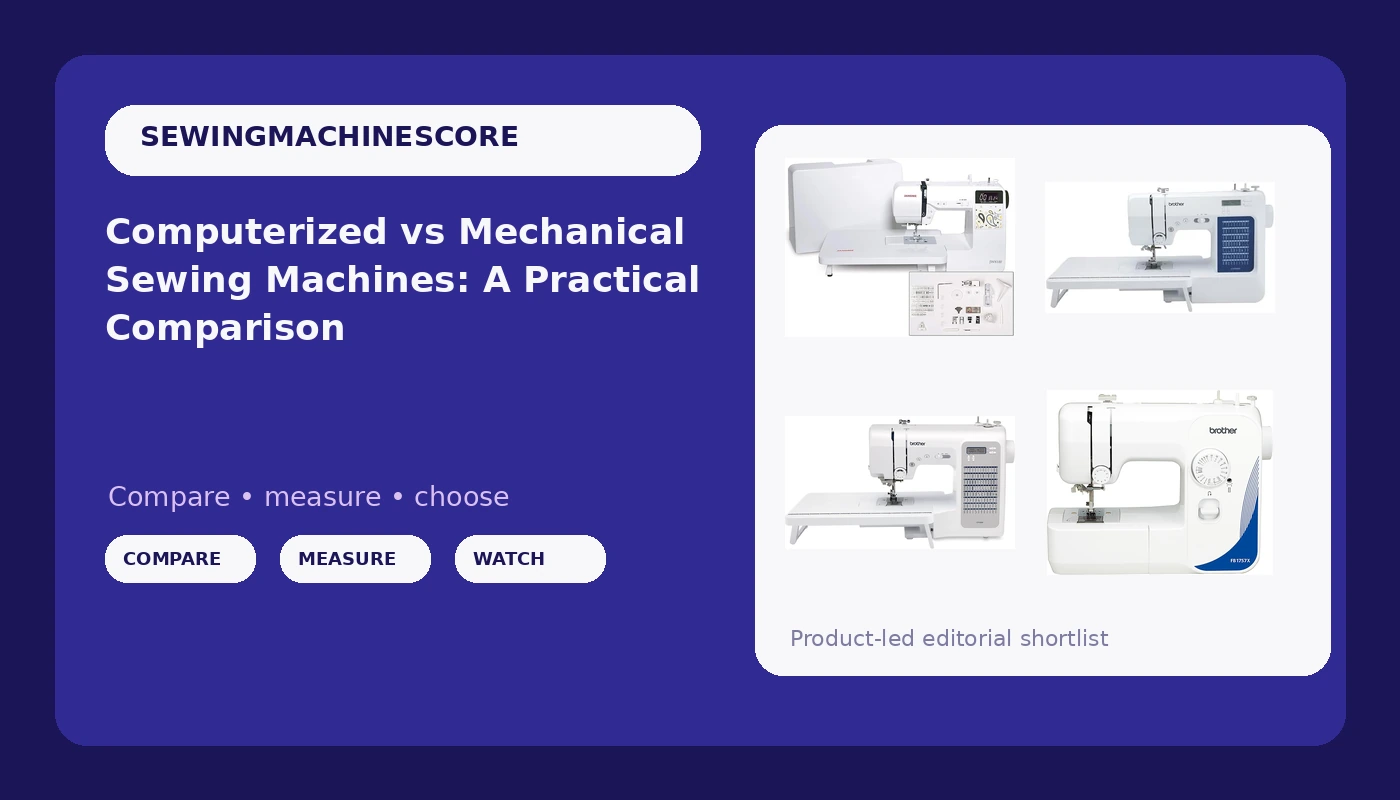
There is a point in every machine purchase where the spec sheet stops being useful. A computerized machine and a mechanical machine both sew a straight seam, and both will frustrate you if you buy for fabric you never actually touch. The computerized vs mechanical sewing machine question really comes down to three things: how you pick a stitch, how the machine builds a buttonhole, and how much electronics you are willing to own when something eventually needs repair.
This is not a ranking. It is a way to read four current machines against the work you actually do, so the feature list on the box lines up with the fabric on your table and the seams you sew most often.
Related: How Stitch Counts Mislead Beginner Machine Shoppers →
Quick answer
Computerized machines put stitch selection on buttons or an LCD screen and generally give you more built-in patterns and more buttonhole styles. Mechanical machines use dials and levers, carry fewer electronic parts, and keep the controls readable at a glance. Choose computerized when your sewing leans on decorative stitches, edge finishing, and one-step buttonholes. Choose mechanical when you want the simplest machine you can maintain yourself and you mostly sew straight and zigzag seams. Neither category is automatically better; the fabric you sew most and the stitches you actually use decide it.
Four useful options
| Model | Best fit | What stands out |
|---|---|---|
| Janome JW8100 Fully-Featured Computerized Sewing Machine | Garment sewing that leans on buttonholes and finishing | 100 stitches, 7 buttonholes, hard cover, extension table, and 22 accessories listed |
| Brother CS7000X Sewing and Quilting Machine | A first machine that also handles quilting | LCD display for stitch selection, listed for both sewing and quilting |
| Brother CP100X Computerized Sewing and Quilting Machine | Computerized control in a plain-feature machine | Computerized stitch selection, listed for sewing and quilting |
| Brother FB1757X Mechanical Sewing Machine | Sewers who want dials and minimal electronics | Mechanical controls rather than a computer board |
Garment-focused: Janome JW8100
The honest trade-off here is that the accessory bundle and the wider stitch menu only pay off if you will use them. If you sew mostly straight seams on cotton, a machine with seven buttonhole styles is asking you to pay for capability you may never open. If you make shirts, waistbands, and anything with a placket, the buttonhole options and the extra table surface do more for you than a higher straight-stitch spec elsewhere.
The detail worth thinking about is the hard cover. A machine that lives on a dining table and gets moved twice a week is a machine that needs somewhere to go. The cover is not glamorous, but it is the accessory people end up buying anyway.
Beginner-friendly: Brother CS7000X
For a beginner, the deciding factor is rarely stitch count. It is whether the machine makes you want to sit down again tomorrow. A display helps because it shortens the gap between wanting a stitch and getting it, and because it makes the machine feel less like a puzzle.
The trade-off is that screens and circuit boards are the parts that eventually fail, and when they do, the repair bill can approach what the machine cost. That is not a reason to avoid computerized machines. It is a reason to keep the pedal away from a surge-prone outlet, to cover the machine when it is not in use, and to accept that a computerized machine is a long-term relationship with a service tech.
Quilting-leaning: Brother CP100X
Quilting and garment sewing pull a machine in different directions, and the label on the box is only a hint. Quilting puts long, layered seams under the needle and punishes a machine that shifts layers. Garment sewing puts curves, darts, and sheer fabrics under the same needle and punishes a machine with abrupt speed changes. A machine billed for both is a machine that has to compromise somewhere.
If quilting is the plan, the accessory question matters more than the machine question. A walking foot is the accessory that stops layers from shifting, and it is the single upgrade that changes how a quilt sandwich behaves under a standard machine. Check what ships in the box before you assume it is there.
Simple and mechanical: Brother FB1757X
Mechanical machines deserve more respect than they get in a market that sells by stitch count. Fewer electronic parts means fewer parts that can die, and a dial that selects a stitch is a dial you can understand without a manual. For a sewer who makes curtains, repairs clothes, and wants the machine to be predictable in five years, that simplicity has a real value.
The trade-off is capability. Mechanical machines generally offer a smaller stitch menu and fewer buttonhole styles than computerized models, and the ones they do offer take more practice to place precisely. You are trading features for durability and lower repair risk. That is a fair trade for some sewers and a bad one for others.
Prices and availability may change. Product images, names, and retailer links must be matched by verified product record. Do not state a current price, rating, stock status, or measured result without current evidence.
What the computerized label actually changes
Marketing treats "computerized" as a quality tier. It is not. It is a description of how the machine makes decisions. On a computerized machine, stitch selection is electronic, the machine often knows where the needle stopped, and one-step buttonholes are built from a sequence the machine runs for you. On a mechanical machine, you move a dial and the internal geometry does the work directly.
Where this shows up most is the buttonhole. A buttonhole is the truest test of a machine's brain, because it requires the machine to reverse direction, change stitch width, and hold a consistent density on both sides. One-step buttonholes exist precisely because that sequence is hard to do by hand on a mechanical machine. If your projects include buttoned garments, weigh buttonhole count and buttonhole style heavily. If they do not, that entire column of the spec sheet is decoration.
The second place it shows up is tension. Balanced tension is the whole craft: the upper thread and the bobbin thread meeting in the middle of the fabric instead of looping on one side. Every machine, computerized or not, has a tension system you may need to adjust as you change fabric weight and thread. A machine is only as good as how repeatably its tension returns to the same setting after you move the dial away and back. That is not something a listing can tell you.
The third place is repair. A mechanical machine can often be serviced by any shop with a screwdriver and patience. A computerized machine may need a board replaced, and boards are the expensive part. This is the real cost of convenience, and it is the reason a mechanical machine still belongs in a comparison for someone who sews hard and often.
How to choose in five steps
- Write down the last five things you sewed and mark which ones needed a buttonhole, a stretch stitch, a decorative stitch, or a blind hem. If four of the five needed only a straight seam, a mechanical machine is enough.
- Count the fabrics you actually sew, not the ones you intend to sew. Lightweight cotton and knits behave nothing alike, and a machine you have not seen run on your fabric is a machine you are guessing about.
- Decide how you feel about repair risk. If a circuit board failure would end your sewing for a month and you would rather it not happen at all, favor mechanical. If you would rather have the feature today and deal with the repair later, favor computerized.
- Check what is in the box. A hard cover, an extension table, and a walking foot prevent three separate purchases, and bundled accessories are the cheapest capability you will ever add.
- Set a budget band and buy inside it, not at the bottom of it. The cheapest machine in a category is usually the one with the shortest accessory list and the least forgiving tension system.
Practical guidance before you buy
- Sew a test seam on three fabrics before you commit, or buy from a seller with a return window you can actually use.
- Keep the manual. Stitch charts are how you rediscover the stitches you forgot the machine had.
- Learn to clean the bobbin area yourself. Bobbin issues are behind a large share of "my machine is broken" reports, and most of them are lint.
- Match the needle and thread to the fabric before you blame the machine. Most tension complaints are needle complaints.
- Treat a service interval like an oil change. A machine that is cleaned and timed lasts years longer than one that is only used.
Which option should you choose?
Choose the Janome JW8100 Fully-Featured Computerized Sewing Machine when your sewing includes buttoned garments, edge finishing, and projects that benefit from a wide stitch menu plus an extension table you did not have to buy separately. Choose the Brother CS7000X Sewing and Quilting Machine when this is your first machine, you want an LCD display to confirm stitch selection, and you want room to grow into quilting without buying a second machine. Choose the Brother CP100X Computerized Sewing and Quilting Machine when you want computerized stitch selection and a quilting-capable machine without paying for the largest feature set in the group. Choose the Brother FB1757X Mechanical Sewing Machine when you sew straightforward seams and hems, you want dials instead of a display, and you would rather not own a machine whose control board can fail.
Nothing in a product listing tells you how a machine handles a denim seam or a slippery lining, and no listing tells you how the tension behaves after twenty minutes of sewing. Those are the questions that decide whether you keep a machine for a decade. Buy where you can test or return.
The bottom line
The spec sheet is not the decision. Your fabric is. Computerized machines earn their place when you use the stitches, the one-step buttonholes, and the display that confirms your choice. Mechanical machines earn their place when the seams are simple and you would rather not gamble on electronics. The Janome JW8100 leans toward the sewer whose projects have buttons and finish work, the Brother CS7000X leans toward the beginner who wants guidance on screen, the Brother CP100X covers quilting and everyday sewing with computerized controls, and the Brother FB1757X is the dial-driven option for sewers who value simplicity over stitch variety. Pick the one that matches the fabric you actually bring home, and check it against your last five projects before you decide.