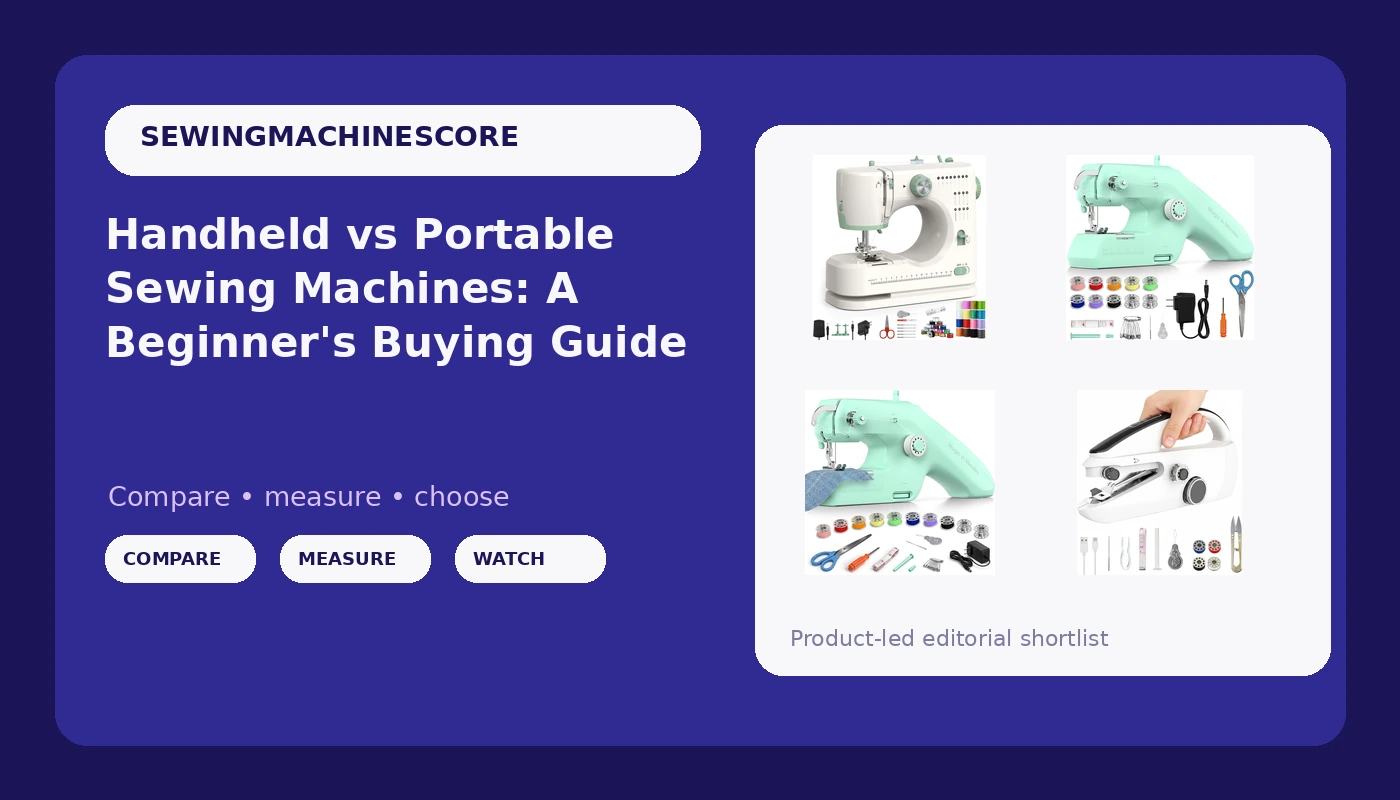
The four machines on this page share a shelf in search results and almost nothing else. Three are handhelds: you hold the tool, guide the fabric, and let the stitch form wherever the fabric already sits. The fourth is a portable machine with a flat bed, a foot pedal, and a bobbin system, which is the setup that lets you sew a straight seam the way a conventional machine does.
That distinction matters more than stitch count. A handheld sewing machine for beginners earns its place in a mending basket: a hem that let go, a seam splitting on a cushion cover, a curtain you cannot take off the rod. It is the wrong tool for cutting a pattern and building a garment, because holding a machine in the air while steering fabric makes a consistent seam allowance almost impossible. Before comparing features, decide which of those two jobs you actually have.
Related: How to Read Your Sewing Machine's Tension Dial →
Quick answer
If your sewing means seams, hems, and the occasional buttonhole on flat fabric, start with the portable machine that has a foot pedal and a quick-place bobbin. It is the only one of the four built like a conventional sewing machine, with a bed to support the fabric and 16 stitch options to work from. If your sewing means repairs on things you cannot easily carry to a table, choose a handheld, and choose between the handhelds on thread system and speed control rather than on the length of the product name. No handheld replaces a machine with a bed when it comes to garment construction.
4 useful options
| Model | Best fit | What stands out |
|---|---|---|
| Sewing Machine 16 Stitches, Portable Dual-Thread Double Needle Sewing Machine with Adjustable Speed, Foot Pedal, and Quick-Place Bobbin, for Home DIY, Beginners, and Adult Crafting. | Sewing at a table: seams, hems, flat-fabric projects | Foot pedal speed control, 16 stitches, dual-thread double-needle setup, quick-place bobbin |
| Double Thread Handheld Sewing Machine for Beginners with Lockstitch | Repairs where the fabric stays put | Double-thread lockstitch specified in the listing |
| Portable Mini Handheld Sewing Machine for Beginners for Mending | A mending basket for short repairs | Mending-focused handheld format |
| Ninonly Handheld Sewing Machine for Beginners, Portable Mini Sewing Machine with Two Speed Modes for Quick Home Repairs Birthday Christmas Mom Valentine's Day Gifts (White) | Quick repairs, and gifting to a new sewer | Two speed modes for more control |
The pedal-driven option: Sewing Machine 16 Stitches, Portable Dual-Thread Double Needle Sewing Machine with Adjustable Speed, Foot Pedal, and Quick-Place Bobbin, for Home DIY, Beginners, and Adult Crafting.
This is the machine to pick if you want to make something rather than fix something. A flat bed holds the fabric level, the foot pedal lets you set speed with your foot instead of your trigger finger, and the quick-place bobbin means the lower thread goes in without a wrestling match. The trade-offs are the usual ones for any machine with a bobbin and a tension path: you wind the bobbin, thread the route correctly, and learn what balanced tension looks like on a scrap of your actual fabric before you commit to a real seam. It also needs a table, which is exactly what a handheld does not. Of the 16 stitches, most beginners settle on two or three and let the rest live in the dial.
The lockstitch handheld: Double Thread Handheld Sewing Machine for Beginners with Lockstitch
A handheld that specifies a lockstitch is doing something more useful than a single-thread novelty tool. A lockstitch uses two threads that interlock inside the fabric, which is why a broken stitch in a lockstitch seam tends not to unravel the way a single-thread chain can. That matters on a repair you want to forget about. The trade-off is the thread path: two threads mean a lower thread or bobbin to load, and doing that on a tool the size of your hand takes patience the first few times. There are no feed dogs moving the fabric for you, so your hands set the line and the machine only supplies the stitch. Budget a few inches of scrap fabric to get your rhythm before you touch the actual repair.
The mending handheld: Portable Mini Handheld Sewing Machine for Beginners for Mending
Mending is its own job with its own rules: short runs, awkward angles, and fabric that stays where it is because taking it down is more work than the repair. That is the case for a mini handheld, and it is a real case. Hem edges on a curtain, a cushion seam that split, a strap that pulled loose, a lining that came away at the wrist. What it will not do is assemble pattern pieces. Small handhelds generally lack a presser foot and a feed system, so the seam line is only as straight as your hand, and anything longer than a few inches starts to wander. If your repair list is longer than four inches per item, this is the wrong category of tool.
The budget handheld: Ninonly Handheld Sewing Machine for Beginners, Portable Mini Sewing Machine with Two Speed Modes for Quick Home Repairs Birthday Christmas Mom Valentine's Day Gifts (White)
Two speed modes sound like a minor feature until you try to sew a straight line with a tool that only runs at one speed. On a handheld, slower is almost always straighter, because you get time to steer. That makes the low setting the one a beginner will actually live in, and the faster mode useful for long, low-stakes runs like a curtain hem where precision matters less than finishing. The gift framing in the listing is worth taking seriously for a different reason: if you are buying this for someone who has never sewn, be honest that it is a supplement to a sewing kit, not a replacement for a machine with a bed. It is a good first tool for repairs. It is a frustrating first tool for making a dress.
Prices and availability may change. Product images, names, and retailer links are matched to verified listings. No current price, rating, stock status, or measured result is stated here without current evidence.
What a handheld machine can and cannot do
A conventional sewing machine moves the fabric for you. Feed dogs under the presser foot pull it forward at a steady rate while you steer, which is why a beginner can sew a straight seam on a machine long before they can sew one by hand. A handheld inverts that relationship. You move the tool, the fabric stays put, and your hand supplies both the speed and the line. That inversion is the whole story of what these tools are good for.
Good for: repairs on fabric that is already where it needs to be, short seams under a few inches, hems on hanging curtains, cushion and pillow seams, loose straps, quick patches on a bag lining.
Poor for: assembling garments from a pattern, quilting, anything requiring a consistent seam allowance across multiple pieces, and long straight seams where drift is visible. Also treat thick, layered fabric with caution. A handheld is a small tool, and denim hems, upholstery weight fabric, and multiple folded layers are where small tools tend to struggle. Test on a scrap of the actual fabric before you start the repair, not after.
Lockstitch, chain stitch, and why the thread path matters
Stitch formation is the most useful thing to understand when you compare handheld machines, because it determines whether a repair holds.
A lockstitch uses two threads. The upper thread and the lower thread interlock inside the fabric, which is what a conventional sewing machine produces. If one stitch breaks, the surrounding stitches generally stay put, and the seam does not pull apart from the end.
A single-thread chain is a different structure. One thread loops through itself, and the resulting seam can unravel from the loose end if it is not secured. Chain stitches are fast to produce and common on simple handheld tools, but for a repair you want to stop thinking about, two interlocking threads are the sturdier choice.
That is why a listing that specifies a double thread and a lockstitch is telling you something real, and why the word "double" in a product name is worth more attention than the number of stitches on a dial. It also explains the trade-off: two threads mean a lower thread path to load, which is more setup and more chance to get it wrong the first time.
Tension is the second half of the story. On a full-size machine you have a dial to adjust. On most handhelds the tension is largely preset, so the practical test is not a setting but a sample: run a line of stitches on the same fabric and thread you plan to use and look at it. Balanced stitches sit flat on both sides. Loops on the underside mean the upper tension is too loose for that combination, and the fix is usually thread weight or needle size rather than a dial.
- Write down the last five sewing tasks you actually did, and how long each seam was.
- If any task involved a pattern, multiple pieces, or a seam longer than a few inches, you need a machine with a bed, not a handheld.
- If every task was a repair on fabric that could not move, a handheld is the right category.
- Compare handhelds on thread system first, then on speed control, then on everything else.
- Before buying, price in thread, needles, and a scrap of test fabric. A machine without the right thread is a paperweight.
Getting a usable stitch out of a small machine
- Test on the exact fabric you are repairing. A handheld that handles cotton jersey may behave differently on canvas.
- Run the slow setting until your lines are straight. Speed is for finishing, not for learning.
- Secure both ends of the seam by hand with a needle and thread, since many handhelds have no reverse.
- Match thread weight and needle size to the fabric; heavy thread in light fabric creates its own tension problems.
- Keep the bobbin area and thread path clean and correctly seated, because most "broken machine" symptoms start there.
Which option should you choose?
Choose the Sewing Machine 16 Stitches, Portable Dual-Thread Double Needle Sewing Machine with Adjustable Speed, Foot Pedal, and Quick-Place Bobbin, for Home DIY, Beginners, and Adult Crafting. when you want to sew seams and hems on flat fabric and you have a table to work at. Choose the Double Thread Handheld Sewing Machine for Beginners with Lockstitch when your repairs need the sturdiest stitch structure of the handheld group. Choose the Portable Mini Handheld Sewing Machine for Beginners for Mending when your list is short repairs on fabric that stays put. Choose the Ninonly Handheld Sewing Machine for Beginners, Portable Mini Sewing Machine with Two Speed Modes for Quick Home Repairs Birthday Christmas Mom Valentine's Day Gifts (White) when you want speed control on a small tool, or when you are buying a first repair tool for someone else.
The honest caveat: these judgments rest on what each listing specifies, not on seam tests across multiple fabric types. If you can, run a sample line on your own fabric before you commit to a full repair.
The bottom line
A handheld and a portable machine solve different problems, and buying the wrong category is the most common beginner mistake in this price range. If you want to make things, the pedal-driven machine with a bed, a bobbin, and 16 stitches is the one that behaves like the tool you are imagining. If you want to stop a hem from unraveling without taking the curtain down, a handheld with a double-thread lockstitch or a controllable two-speed motor will do the job. Buy for the sewing you did last month, not for the sewing you hope to do next year.