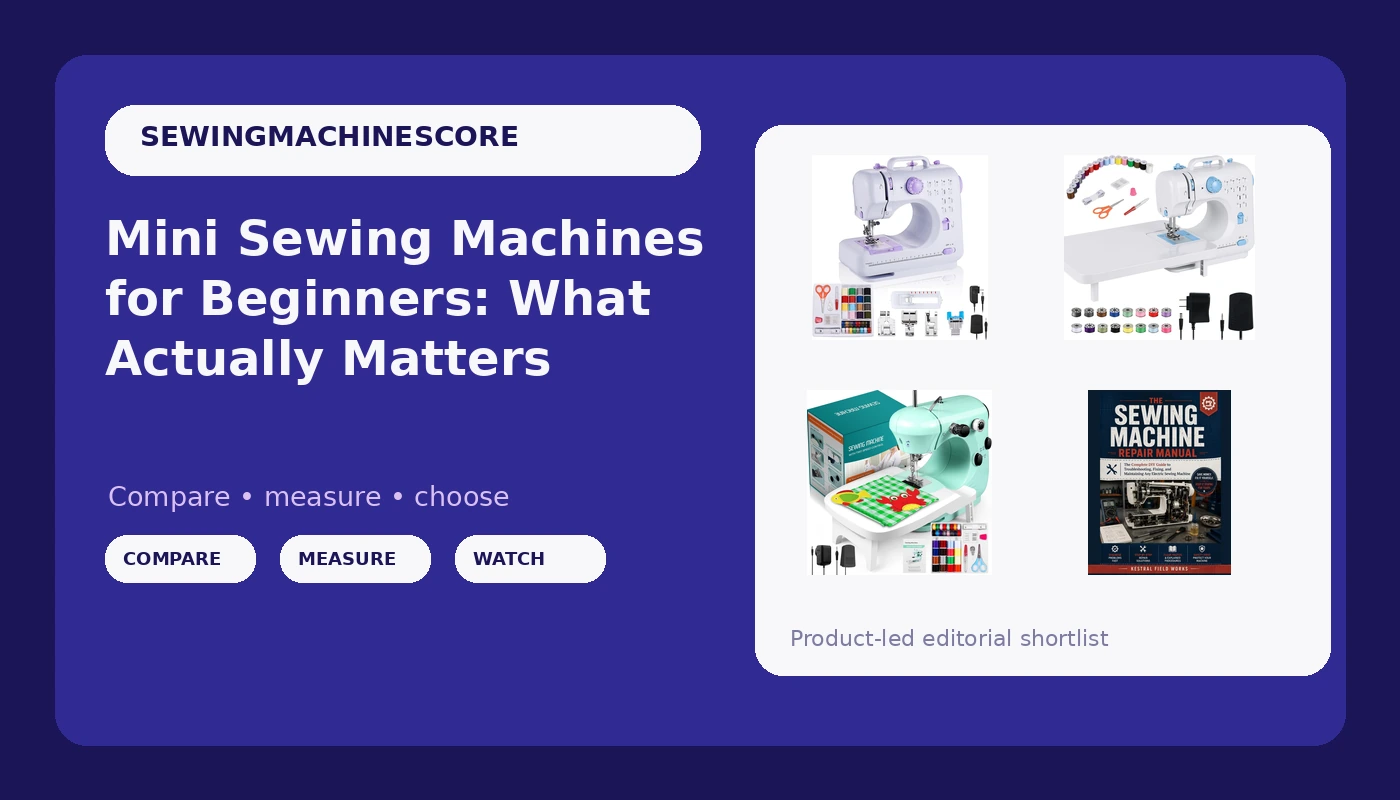
A mini sewing machine is the cheapest honest way to find out whether you actually enjoy sewing. It is also one of the most common first purchases people regret. The gap between a usable mini sewing machine for beginners and a frustrating one is not stitch count, and it is not the color of the plastic housing. It is whether the machine can hold a balanced stitch on the fabric you actually plan to use, and whether the parts that matter, meaning the bobbin area, the tension dial, and the presser foot, are built to be adjusted rather than merely looked at. This guide walks through four products that sit at the beginner end of the market: three portable machines and one repair manual that earns its shelf space no matter which machine you end up with.
Related: How to Test a Sewing Machine Before You Buy It →
Quick answer
A portable mini machine is the right first purchase if your projects are light: quilting cotton, simple mending, small bags, doll clothes, and straight seams on thin material. If you want to sew denim, canvas, upholstery, or anything with several bulky layers, a full-size machine is the better spend, and nothing in this price band changes that. If you already own a machine that skips stitches or jams, the repair manual is the more useful purchase.
4 useful options
| Model | Best fit | What stands out |
|---|---|---|
| Rxmeili Portable 12-Stitch Sewing Machine, 42-Pc Sewing Kit for Beginners | A complete first kit in one box | 12 built-in stitches plus a 42-piece accessory kit |
| Mini Sewing Machine for Beginners & Kids with Extension Table, Portable | A shared table and a young sewer | Portable build with a removable extension table |
| Sewing Machines, Mini Sewing Machine for Beginner with Eco-Friendly Material, Dual Speed Portable | A gift with a gentler learning curve | Dual speed control and an extension table |
| The Sewing Machine Repair Manual: The Complete DIY Guide to Troubleshooting, Fixing, and Maintaining Any Electric Sewing Machine | A machine that is already misbehaving | Troubleshooting and maintenance guidance for electric machines |
The complete starter kit: Rxmeili Portable 12-Stitch Sewing Machine
The kit is the real argument here. Beginners lose more evenings to missing bobbins and blunt needles than to any machine defect, and a box that arrives complete removes that entire category of delay. The trade-off is the one every portable machine shares: limited space under the arm, limited presser foot clearance, and a stitch quality that depends heavily on using the right needle and thread weight. Treat the 12 stitches as a set of utility options rather than a creative palette. Straight stitch, zigzag, and a stretch stitch will cover almost everything you do in your first year.
The shared-table option: Mini Sewing Machine for Beginners & Kids with Extension Table, Portable
The extension table is not a gimmick. On a machine this small, the standard bed gives you very little room to support a piece of fabric, which is exactly when seams start curving and hems start wobbling. Attaching a table changes how the fabric feeds, and feeding is most of what determines whether a beginner seam looks straight. The kids angle matters too, but read it as a statement about the learning curve, not about safety. Any machine with a needle in it deserves adult supervision and a clear rule about where fingers stay.
The dual speed option: Sewing Machines, Mini Sewing Machine for Beginner with Eco-Friendly Material, Dual Speed Portable
Dual speed is a genuinely useful feature for a beginner, and it is the one spec on this list I would weigh heaviest after stitch quality. Running slowly while you learn to guide fabric teaches your hands what correct feeding feels like. Running fast too early teaches you how to frog, which is the most practiced skill in sewing and the least enjoyable one. The light build cuts both ways: easy to move and store, but a lighter machine can walk across the table when you sew at speed, so a nonslip mat under it is a cheap fix.
The troubleshooting companion: The Sewing Machine Repair Manual
Most machines that get thrown away were never broken. They were misthreaded, or their bobbin case had a tangle of lint under it, or their needle was installed backward. A reference that walks through the elimination process is worth more than a replacement machine if you already own something that stitches. Buy this one if your current machine is misbehaving, or buy it alongside a mini machine so that the first jam does not end the hobby.
Prices and availability may change. Product images, names, and retailer links must be matched by verified ASIN. Do not state a current price, rating, stock status, or measured result without current evidence.
What a mini machine can and cannot sew
The honest dividing line is fabric weight and layer count. A portable mini machine handles quilting cotton, cotton blends, muslin, lining fabric, simple knits with the right needle, and small projects that stay under a few layers. It does not handle denim hems, canvas tote bases, leather, or quilt sandwiches with batting. It is not a matter of brand or price. It is throat space, motor torque, and presser foot clearance, and those three things are physically limited on a machine that fits in a tote bag.
Within that boundary, a mini machine is genuinely capable. Straight seams on cotton, zigzag finishing on raw edges, basic buttonholes on lighter machines, and mending are all realistic. What you are buying is a machine that teaches you tension, threading, and fabric handling without a large investment. What you are not buying is a machine that grows with you. If your interest survives the first three months, you will likely want a full-size machine, and that is a normal progression rather than a failure of the first purchase.
How to read a beginner machine listing
Listings in this category lean hard on numbers. Stitch count sounds impressive until you notice that most projects use three of them. Accessory counts matter more, because a kit that includes bobbins, needles, a seam ripper, and a measuring tape saves real money and real time. Look for the boring specs: whether an extension table is included, whether the speed is controllable, whether the machine takes standard bobbins or proprietary ones, and whether replacement needles are a common type you can buy anywhere.
Then think about the fabric you actually sew, not the fabric you imagine sewing. If you are making doll clothes and patching knees, a portable machine is a match. If you are planning a quilt, a costume with structured pieces, or anything with multiple thick layers, save longer.
- Decide what fabric and how many layers your next three projects involve.
- Confirm the machine includes an extension table or a wide enough bed for those projects.
- Check that bobbins and needles are standard types you can restock easily.
- Weigh speed control over stitch count if you are still learning to guide fabric.
- Set aside a small budget for a repair or maintenance reference before something jams.
Practical guidance
- Run a test seam on scrap fabric before starting any project, and adjust the tension dial while you watch the stitch form.
- Match the needle to the fabric, because a dull or wrong needle causes more skipped stitches than a bad machine.
- Clean lint out of the bobbin area regularly, since that is the single most common cause of a machine that suddenly stops stitching.
- Use a nonslip mat under a lightweight portable machine so it stays put when you sew faster.
- Keep your manual, your receipt, and your accessory kit together, because the missing presser foot is always the one you need next.
Which option should you choose?
Choose the Rxmeili Portable 12-Stitch Sewing Machine when you want a complete first kit with the accessories already in the box and you are sewing light fabric projects. Choose the Mini Sewing Machine for Beginners & Kids with Extension Table when the machine will be shared with a younger sewer or stored between sessions, and you want the extra work surface. Choose the Sewing Machines, Mini Sewing Machine for Beginner with Eco-Friendly Material, Dual Speed Portable when you want speed control while you learn and a light machine that is easy to put away. Choose The Sewing Machine Repair Manual when you already own a machine that skips, jams, or tensions badly, or when you want a reference on hand for the first problem.
The caveat that applies to all three machines is the same: none of them replaces a full-size machine for heavy work, and none of them should be judged by stitch count alone. Buy for the fabric you actually sew this month.
The bottom line
A mini portable machine is a reasonable first purchase if your projects are light and your goal is to learn threading, tension, and fabric control without a large outlay. Pick the one whose included accessories and work surface fit your actual projects, and plan on a full-size machine later if the hobby sticks. If you already own a machine that is not stitching correctly, spend on the repair manual first, because a misthreaded or lint-clogged machine is far more common than a dead one.