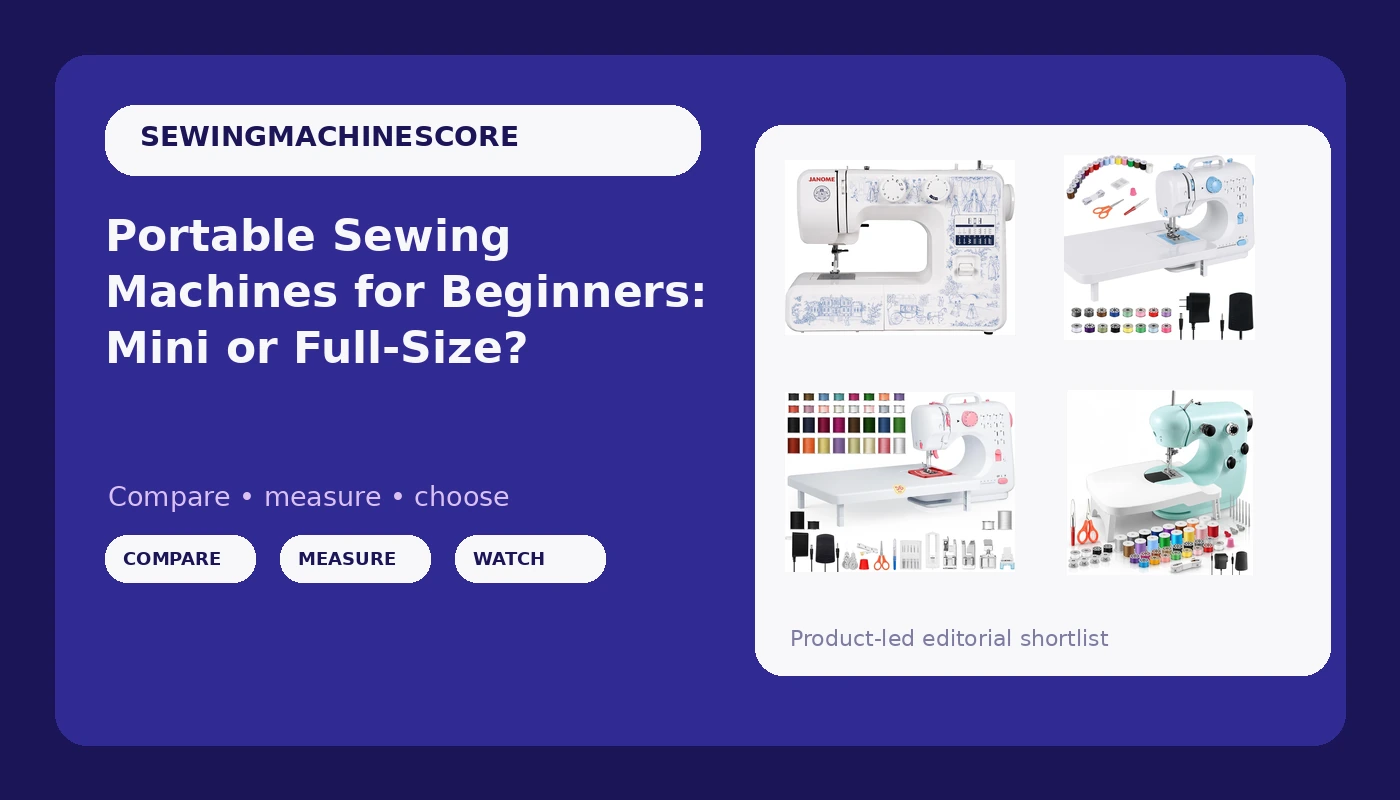
Most people shopping for portable sewing machines for beginners are staring at a page of listings that all use the same four words: easy, portable, beginner friendly. The listings are not wrong. They are describing different machines. A 15-stitch Janome and a compact mini with a thread kit can both honestly be called beginner friendly, and they are built for different first projects. One is designed to run a straight seam and keep running for years. The others are designed for small, flat, light-fabric work, and their size is the whole point.
That gap is where first purchases go wrong. Someone buys a mini machine because it fits on a shelf, then tries to hem denim with it. Someone else buys far more machine than a felt ornament project ever needed. The four machines below are sorted by what they are actually built to do, so your first machine matches the sewing you will realistically do in the next month.
Related: How to Choose Your First Sewing Machine →
Quick answer
The Janome Toile Romance Easy-to-Use 15-Stitch Sewing Machine is the only option in this group from a company whose main business is sewing machines, and its 15 built-in stitches cover the utility work most beginners need. The other three are compact and mini machines built for smaller jobs: light fabric, flat seams, crafts, and simple repairs. Mini machines trade fabric range and stitch power for size and simplicity, so they suit a beginner with a specific small project rather than a beginner who wants one machine for everything.
Four useful options
| Model | Best fit | What stands out |
|---|---|---|
| Janome Toile Romance Easy-to-Use 15-Stitch Sewing Machine Officially Licensed Collection | Beginners who want a real sewing machine brand to grow with | 15 built-in stitches, officially licensed Toile Romance collection |
| Sewing Machine for Beginners, Portable Mini Sewing Machine with 57-Piece Kit | Beginners who want one box with everything included | 2-speed electric operation, foot pedal, extension table, 57-piece kit |
| Portable Sewing Machine for Beginners, Compact Electric Sewing Machine with 12 Built-In Stitches | Crafters who want a few stitch choices and thread variety | 12 built-in stitches, reverse sewing, LED light, 32-color thread kit |
| Mini Sewing Machine for Beginners & Kids with Extension Table, Portable | Kids and absolute first-timers doing small flat projects | Compact portable format, extension table, listed for beginners and kids |
The brand-name pick: Janome Toile Romance Easy-to-Use 15-Stitch Sewing Machine
The case for starting here is unglamorous and correct: Janome makes sewing machines as its main line of business, and the machine carries a brand name that parts and accessories are built around. A 15-stitch count is modest next to computerized machines, and for a beginner that is usually the right call. Straight stitch and zigzag do the overwhelming majority of real work, and the remaining stitches in a set this size are utility and decorative options you reach for occasionally rather than daily.
The trade-off is footprint and price next to the minis. If your sewing life consists of mending one hem twice a year, that trade may never pay off. If you want to make garments, curtains, or costumes, it is the option here that is built for that trajectory.
The all-in-one kit: Sewing Machine for Beginners, Portable Mini Sewing Machine with 57-Piece Kit
The appeal of a bundled kit is that you do not spend your first week hunting for bobbins, needles, and a seam ripper separately. The listing describes a 57-piece kit, and the exact contents are itemized on the product page, so read that list before assuming it covers a specific notion you need. What the bundle does not change is the machine underneath: this is a mini format, which means light fabric, small flat pieces, and modest seam lengths rather than bulky layers.
The extension table is the quietly useful part of this package. Mini machines have a small built-in work surface, and the clip-on table widens it enough that a small tote bag panel or a craft project does not fight you the whole way across.
The stitch-variety mini: Portable Sewing Machine for Beginners, Compact Electric Sewing Machine with 12 Built-In Stitches
Two features on this listing matter more than the stitch count. Reverse sewing lets you backstitch at the start and end of a seam to lock it, which is the difference between a seam that holds and a seam that quietly unravels after three washes. The LED light matters more than beginners expect, because most of the frustration of learning to sew happens on dark fabric under a dim kitchen light.
The 32-color thread kit is a genuine convenience for craft work and color matching, but treat it as accessories rather than capability. A dozen stitches and a rainbow of thread on a compact machine still means light to medium fabric and small projects. Buy it for crafts, repairs, and kids' projects, and it will do exactly what the listing says.
The kids-and-first-timer mini: Mini Sewing Machine for Beginners & Kids with Extension Table, Portable
A machine aimed at kids is doing a different job than a machine aimed at adults. It needs to be small enough to sit on a table, light enough to move, and simple enough that the person using it is not managing five settings at once. This listing covers those basics and includes the extension table, which is the accessory that makes small projects less awkward.
Two things are worth saying plainly. A kids' machine still needs adult supervision, and a mini machine will not sew denim, canvas, or thick layers no matter who is sitting in front of it. Used for what it is meant for, felt, cotton, simple repairs, and practice on scraps, it is a reasonable first taste of sewing. If the child sticks with it, expect to move up to a full-size machine later.
Prices and availability may change. Product images, names, and retailer links are matched to verified listings. No current price, rating, stock status, or measured result is stated here without current evidence.
What a beginner machine actually has to do
Strip away the marketing and a sewing machine has one core job: form a balanced stitch by pulling thread from the top and the bobbin at the same rate. Everything else, the lights, the kits, the stitch menus, sits on top of that foundation. On a full-size machine, the tension dial, the presser foot pressure, and the feed dogs can all be adjusted to handle different fabrics. On a mini machine, the same systems exist but in a smaller, simpler, less adjustable form, which is why the fabric range narrows.
This is also why brand matters more than stitch count. A machine from a sewing machine company has a parts pipeline and a manual written for sewers. A no-name compact machine is a self-contained purchase: when a plastic gear wears out, the machine is usually done. Neither of those is a scandal, and for a craft machine it may not matter. It matters a great deal if you plan to sew regularly for years.
The practical test for any beginner machine is fabric range. Ask what it will sew. A full-size machine is generally built to handle light cotton through mid-weight wovens, and often more. A mini is built for light fabric, flat seams, and small pieces. Buy inside that range and the machine feels capable. Buy outside it and you will conclude, wrongly, that you are bad at sewing.
Stitch count, speed settings, and the numbers that matter
Stitch counts are the most inflated spec in the category. A 15-stitch machine and a 12-stitch machine are not far apart in real use, because almost all beginner sewing runs on straight stitch and zigzag. The rest of the set is utility and decorative work you use occasionally. More stitches never hurt, but they are not a reason to choose one machine over another at this level.
Speed settings deserve a closer look, because "2-speed" and "foot pedal" are not the same thing. A two-speed machine gives you two fixed motor speeds, and you control the rest by how you feed the fabric. A foot pedal gives you continuous control, which is how most people actually learn, since slowing down at a curve is the entire skill. When a listing mentions both, the pedal is the part that helps you improve.
Accessory counts follow the same logic. A 57-piece kit and a 32-color thread kit are convenience, not capability. They save you a shopping trip, and that is worth something, but they do not widen the fabric the machine can handle or improve the stitch it forms. Judge the machine by its mechanism and its brand, then let the bundle be a bonus.
- Decide what fabric you will sew most: light cotton and felt for a mini, mid-weight wovens and garments for a full-size machine.
- Decide the largest project you can picture finishing this year, and buy for that size, not for an imagined future.
- Check whether the listing includes a foot pedal, an extension table, and a light, since those three affect daily use more than stitch count.
- Read the full accessory list on the product page so you know which notions you still need to buy.
- Set a budget for the machine and a separate small budget for thread, needles, and fabric, because the machine is rarely the whole cost of starting.
Practical guidance before you buy
- Match the machine to the fabric, not to the project photo. Mini machines and light fabric belong together.
- Keep the manual, or save it, because tension and bobbin questions are the two things every beginner eventually asks.
- Buy a seam ripper, extra bobbins sized for your machine, and a pack of universal needles at the same time as the machine.
- Practice on scraps before the real project. Straight lines on scrap fabric teach more than any tutorial.
- If a child is the primary user, plan the supervision and the storage spot before the machine arrives.
- Treat any machine listed as heavy duty on a compact body as a marketing phrase, and check what the listing actually says it sews.
Which option should you choose?
Choose the Janome Toile Romance Easy-to-Use 15-Stitch Sewing Machine when you want one machine from an established sewing brand and expect to sew garments, home items, or costumes over time. Choose the Sewing Machine for Beginners, Portable Mini Sewing Machine with 57-Piece Kit when you want the smallest possible setup with everything in one order and your projects are crafts and simple repairs. Choose the Portable Sewing Machine for Beginners, Compact Electric Sewing Machine with 12 Built-In Stitches when reverse sewing, a work light, and thread variety matter to you more than fabric range. Choose the Mini Sewing Machine for Beginners & Kids with Extension Table, Portable when the machine is for a child or an absolute first-timer doing small flat work.
One caveat applies to all four. The feature lists here come from the product listings, and the descriptions of what mini machines can and cannot sew are general to the format rather than measured results for these specific units. Before you buy, read the current listing for the exact stitch chart, accessory contents, and stated fabric recommendations.
The bottom line
These four machines are not really competitors, they are two different answers. If you want to learn to sew and keep sewing, the Janome Toile Romance is the only option here built like a long-term machine, with a brand behind it and a 15-stitch set that covers everyday work. If you want a small, inexpensive way to start, to craft, to repair, or to hand a child a first machine, the mini and compact options do that job, provided you keep them on light fabric and small projects. Buy for the sewing you will actually do next month, and the machine will feel like the right one.