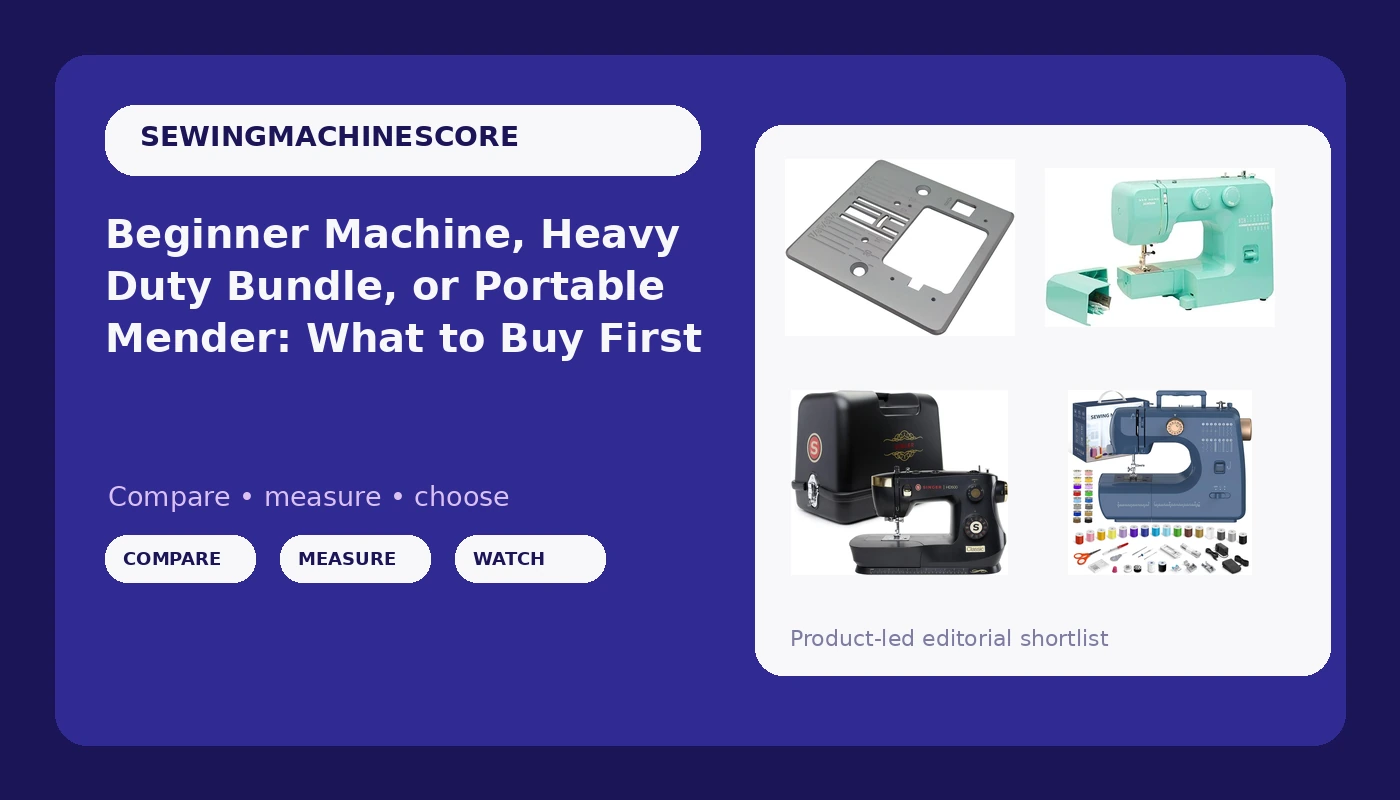
Most people shopping for sewing equipment are not choosing between four similar machines. They are choosing between four different jobs: learning to sew, moving up to a full-size machine that arrives with everything in one box, repairing denim and hems without clearing the dining table, or keeping an older Singer running instead of replacing it. A beginner sewing machine setup looks nothing like a mending kit, and a replacement part is not a machine at all. The four products below cover those four jobs, and the trick is to buy the one that matches the sewing you already do rather than the one with the longest feature list.
Related: How to Read Thread Tension on a New Machine →
Quick answer
If you want one machine to learn on, the Janome Arctic Crystal is the entry model here that is described by its maker as built for beginners, with an interior metal frame, a bobbin diagram, and tutorial videos. If you want a full-size machine plus a case and bundled extras in a single purchase, the SINGER Super Bundle with the Heavy Duty 500 is the one that covers that ground. The 12V 24W portable machine is a mending and denim tool rather than a substitute for a full-size machine. The HONEYSEW throat plate is a replacement part for specific Singer models, and it only makes sense if you already own one of them.
4 useful options
| Model | Best fit | What stands out |
|---|---|---|
| Janome Arctic Crystal Easy-to-Use Sewing Machine | Learning to sew garments, patchwork, and light quilting | Interior metal frame, bobbin diagram, and tutorial videos listed as part of the package |
| SINGER® Super Bundle, Heavy Duty 500 Sewing Machine with Carrying Case | One purchase that covers a full-size machine and transport | Bundle format pairs the machine with a carrying case |
| 12V 24W Motor Portable Sewing Machine for Home Mending & Denim | Mending, hems, and denim repairs where space is tight | Compact portable format with a 12V 24W motor listed in the name |
| HONEYSEW Needle Throat Plate Q60D | Replacing a damaged plate on a listed Singer model | Model-specific fit list covering several Singer 3300, 4400, and 5500 series machines |
The beginner machine: Janome Arctic Crystal Easy-to-Use Sewing Machine
The phrase that matters here is "light quilting." A machine positioned for garments and light quilting is built around medium-weight fabric, which is exactly what a beginner sews. What it does not promise is the throat space or the punching power for a queen-size quilt sandwich or a stack of denim. If your ambition is bags, canvas, or upholstery, read the rest of this list before you commit. If your ambition is a skirt, a pillowcase, and a first attempt at a small quilt, this is the shape of machine that will not fight you on day one.
The bundle: SINGER® Super Bundle, Heavy Duty 500 Sewing Machine with Carrying Case
Heavy Duty is a product line name, not a measurement. It tells you which family the machine belongs to, and it does not tell you the fabric weight the machine will handle comfortably. Before buying any machine with that word on the body, look up the spec sheet and check the presser foot pressure, the maximum stitch width, and whether the accessory list includes the feet you need for the work you do. The case is the quieter advantage of this listing: a machine that has a home gets used more than one that lives in a closet under a stack of fabric.
The portable mender: 12V 24W Motor Portable Sewing Machine for Home Mending & Denim
A 24W motor is the detail to sit with. Motor wattage is one of the few honest numbers on a sewing machine listing, because it describes the electrical input rather than a marketing mood. Compare it directly with the wattage listed for any full-size machine in your budget. What a portable machine of this class does well is short seams: a hem, a split seam, a patch on a knee. What it does not do well is run a long seam at speed through several layers, because small motors and light frames give up heat and stability before a full-size machine does.
The replacement part: HONEYSEW Needle Throat Plate Q60D
This is the item most people find only after a problem starts. When a needle has struck the plate, it leaves a burr, and that burr grabs thread and shreds fabric edges. The symptom looks like a tension fault, so people spend an evening turning the tension dial when the real fix is a flat metal plate. Check the model number stamped on your machine before ordering, and check the plate itself for grooves or a rough spot under a fingernail.
Prices and availability may change. Product images, names, and retailer links are matched to verified listings. No current price, rating, stock status, or measured result is stated here without current evidence.
What each type of purchase actually solves
Sewing equipment fails people not because it is bad but because it is matched to the wrong job. A full-size machine solves volume: it has the frame mass, the throat space, and the motor headroom to run long seams and take a walking foot. A portable machine solves location: it fits where a full-size machine does not, and it comes out for ten minutes of mending instead of an afternoon of sewing. A bundle solves logistics: one order, one case, one set of accessories, no second trip for the thing you forgot. A part solves a specific failure: something on a machine you already own has worn out, and the rest of the machine is fine.
The variable that decides which of these you need is fabric, not stitch count. Denim, canvas, and multiple layers of anything demand needle penetration force and a frame that does not flex. Cotton, linen, and light knits are forgiving, and almost any machine with a straight stitch will handle them. Light quilting sits in the middle: a small quilt top is not heavy, but it is bulky, and bulk needs throat space. Write down the last three things you sewed or wanted to sew before you read another product page. That list is a better buying guide than any feature table.
Buttonholes deserve their own mention, because they expose how well a machine's feed and stitch regulation actually work. If the machine you are considering will be used for garments, look for a machine with a buttonhole function you can test in a store or return without argument. A machine that makes a clean, even buttonhole is a machine with a brain that is doing its job.
How to decide in five steps
- List the last three projects you completed or abandoned, and note the fabric weight of each one.
- Match that list to a machine class: full size for garments and regular work, compact for mending and small spaces.
- Decide whether you need one machine or two roles covered, since a portable mender and a full-size machine do not overlap much.
- Check what is in the box, specifically the case, the presser feet, the bobbins, and the needles, because those extras add up.
- If you are buying a part instead of a machine, confirm the model number stamped on your machine matches the fit list exactly.
Practical guidance for a setup that keeps working
- Keep a seam journal: fabric, stitch length, tension setting, and a one-line verdict. It turns guesswork into a record.
- Change the needle on a schedule. A dull or bent needle imitates a tension problem almost perfectly.
- Learn the bobbin case before you blame the machine. Bobbin issues sit behind a large share of "my machine is broken" moments.
- Check the throat plate for burrs whenever a stitch problem appears suddenly, especially after a needle breaks.
- Read the accessory list before buying presser feet, since feet are machine-specific and returns are a hassle.
- Treat a portable machine as a mending tool. Do not ask it to run a long seam at speed through heavy layers.
Which option should you choose?
Choose the Janome Arctic Crystal Easy-to-Use Sewing Machine with Interior Metal Frame, Bobbin Diagram, Tutorial Videos, Made with Beginners in Mind for Garments, Patchwork, Light Quilting when you are learning and want one machine for garments, patchwork, and light quilting. Choose the SINGER® Super Bundle, Heavy Duty 500 Sewing Machine with Carrying Case when you want a full-size machine and a case in a single purchase and would rather not shop for accessories separately. Choose the 12V 24W Motor Portable Sewing Machine for Home Mending & Denim when mending and denim repairs are the actual job and space is the constraint. Choose the HONEYSEW Needle Throat Plate Q60D for Singer 3321, 3323, 44S, 4411 Heavy Duty, 4423 Heavy Duty, 4452, 5511 Scholastic, 5523, 5532 when you already own one of the listed Singer models and the plate on it is damaged.
One caveat applies to all four. The descriptions here come from the product listings, not from a seam test on five fabric types, so treat every claim about ease of use and capability as a starting point for your own research. Check the return window before you buy, and run your own straight stitch test on the lightest and heaviest fabric you plan to sew as soon as the box arrives. That test tells you more than any listing does.
The bottom line
These four products are not competitors, and treating them as one shopping decision is the mistake. A beginner machine, a full-size bundle, a portable mender, and a replacement plate each answer a different question about how and where you sew. Buy the beginner machine if you are learning, the bundle if you want a complete full-size setup in one order, the portable machine if your sewing is mostly repairs, and the part if your machine already works and one component does not. Match the purchase to the fabric and the table you actually have, and you will spend less time troubleshooting and more time sewing.