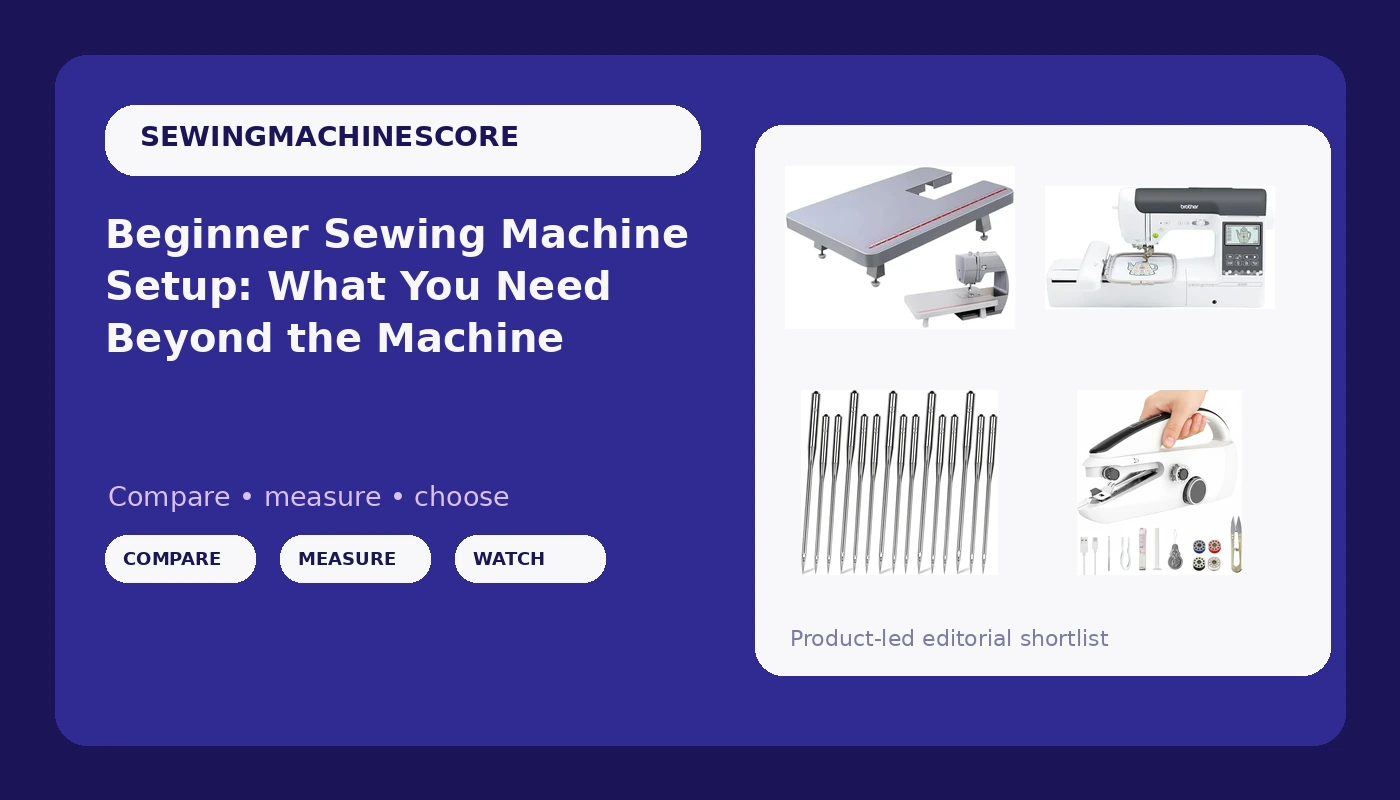
Most of the money in a beginner sewing machine setup goes to the machine, and almost none of it goes to the parts that decide whether the machine actually works on the fabric in front of you. A needle too fine for denim snaps at the eye. A heavy quilt drags off a small work surface and pulls the seam crooked. A torn seam at nine at night does not deserve a full setup session with the table cleared and the good thread out. The four items below cover four separate jobs: the machine, the surface it works on, the needles it consumes, and the small repairs that never justify setting up at all. They are not interchangeable, and the right pick depends on which of those jobs is currently giving you trouble.
Related: Sewing Machine Needles: A Sizes and Fabrics Primer →
Quick answer
Build a beginner sewing machine setup around the machine first, then add only the pieces that match it. A computerized sewing and embroidery machine covers both straight sewing and hoop embroidery in one unit. An extension table is worth buying only if you own one of the Singer heavy duty models it is cut for. An assorted needle set in five sizes is the item most likely to change what an existing machine can handle, because most skipped stitches and snapped threads are a needle problem rather than a machine problem. A handheld mini machine is a repair tool, not a substitute for a full-size machine, and it should be judged that way.
Four useful options
| Model | Best fit | What stands out |
|---|---|---|
| Brother SE2000 Sewing and Embroidery Machine Computerized | Sewists who want standard sewing and hoop embroidery in one unit | Computerized sewing and embroidery combined in a single machine |
| Sewing Machines Extension Table For Singer 4411, 4423, 4432,4452,5511,5523 Heavy Duty Sewing Machines (Gray) | Owners of the specific Singer heavy duty models listed | Made for named Singer model numbers rather than sold as a universal fit |
| 50 Pcs Universal Sewing Machine Needles HAX1,Assorted 65/9, 75/11, 90/14, 100/16 110/18 Ideal for Fabrics, Heavy Duty Sewing Machine Needle for Thick Fabric Including Canvas Leather Embroidery Jeans | Anyone who sews more than one fabric weight | Five assorted needle sizes in one set |
| Ninonly Handheld Sewing Machine for Beginners, Portable Mini Sewing Machine with Two Speed Modes for Quick Home Repairs Birthday Christmas Mom Valentine's Day Gifts (White) | Small repairs away from the main machine | Two speed modes in a handheld, portable format |
The machine: Brother SE2000 Sewing and Embroidery Machine Computerized
The trade-off with a computerized machine is the electronics. Mechanical machines fail in ways a patient owner can often fix: a bent lever, a slipped belt, a bobbin case with lint packed under the tension spring. Computerized machines add a board, a screen, and a set of sensors, and when any of those fail the repair estimate can approach the cost of the machine itself. That is not an argument against buying one. It is an argument for buying deliberately, from a brand with a service network, and for keeping the machine out of a damp garage. The other honest cost is embroidery itself: hooping, stabilizer, and thread changes make a machine-embroidered design slower than the same shape stitched by hand-guided sewing. If you want embroidery occasionally and seams constantly, one unit that does both saves space rather than time.
The work surface: Sewing Machines Extension Table For Singer 4411, 4423, 4432,4452,5511,5523 Heavy Duty Sewing Machines (Gray)
An extension table is the least glamorous item here and the one that quietly solves a specific frustration. Standard machine beds are small; a quilt, a curtain panel, or a long coat seam hangs off the left side of the needle and drags the fabric down, which is one of the ordinary reasons a seam curves when it should run straight. Raising the work to bed height removes that drag. The catch is compatibility. This table is listed for six Singer heavy duty model numbers, and a table cut for one machine's free arm will not seat properly on another. If your machine is not on that list, this specific table is not your answer; look for one matched to your own model instead. It also does nothing for stitch quality, which comes from the machine and the needle, not the table.
The needles: 50 Pcs Universal Sewing Machine Needles HAX1,Assorted 65/9, 75/11, 90/14, 100/16 110/18 Ideal for Fabrics, Heavy Duty Sewing Machine Needle for Thick Fabric Including Canvas Leather Embroidery Jeans
Needles are consumables, and they wear out faster than most beginners expect. A needle that has punched through a few hundred yards of cotton is dull, and a dull needle thumps, skips stitches, and snags knits. An assortment removes the excuse to keep sewing with a worn one. The five sizes here run from 65/9 up to 110/18, which spans lightweight fabric through denim and canvas, and the listing describes the set as suited to canvas, leather, embroidery, and jeans. Treat that as the listing's description rather than a promise about your machine: match the needle size to the fabric first, then make sure the fabric is something your machine is rated to handle. Confirm in your manual that your machine takes a flat-shank HAX1 needle, since industrial and specialty machines can specify something else.
The quick-repair tool: Ninonly Handheld Sewing Machine for Beginners, Portable Mini Sewing Machine with Two Speed Modes for Quick Home Repairs Birthday Christmas Mom Valentine's Day Gifts (White)
A handheld mini machine is the item on this list that people most often buy for the wrong reason. It is not a beginner sewing machine; it is a repair tool. Its useful job is the two-inch seam on a curtain hem, the ripped plush toy, the loose strap, the thing you would otherwise glue. Expect it to run a straight seam on light and medium fabric while you hold the work with one hand and guide the machine with the other, which is a different skill from sitting at a machine with both hands free. Tension control on handheld units is limited by their size, and heavy layers are not what they are built for. As a gift for someone who has never sewn, it is a low-commitment way to find out whether they enjoy the work at all.
Prices and availability may change. Product images, names, and retailer links are matched to verified listings. No current price, rating, stock status, or measured result is stated here without current evidence.
Why the machine is only part of a beginner sewing machine setup
A sewing machine forms a lockstitch: the needle carries the upper thread down through the fabric, a hook catches it, and the bobbin thread interlocks with it in the middle of the seam. Everything that goes wrong with a stitch happens inside that small loop. The needle has to be the right size for the fabric so it can push through without flexing. The thread has to be the right weight for both the needle and the fabric so it can pass through the eye and lie flat in the seam. The tension has to be balanced so the knot sits inside the fabric instead of pulling the bobbin thread up to the top or dragging the upper thread down to the bottom.
None of that is fixed by buying an accessory. An extension table supports the fabric, a needle assortment lets you match the needle to the cloth, and a handheld machine handles jobs too small to set up for. The machine is still the piece that has to hold tension and form a consistent stitch. This is why the order of buying matters: machine first, consumables second, conveniences last.
How to read needle sizes and fabric weights
A needle labeled 90/14 carries two numbers. The first is the American size, the second is the metric size, and they describe the same needle. Larger numbers mean a thicker needle with a bigger eye. So 65/9 is a fine needle for lightweight fabric, 75/11 is a light-to-medium needle, 90/14 is the general-purpose middle of the range, and 100/16 and 110/18 are heavy needles for denim, canvas, and similar weights.
One detail worth noticing in this particular assortment is the gap: it moves from 75/11 to 90/14 without an 80/12 in between. Size 80/12 is a very common default for medium cotton and quilter's cotton, so if your machine came with one, keep it and treat this set as the sizes above and below your everyday needle rather than a replacement for it.
Needle type matters as much as size. Universal needles suit woven fabric. Ballpoint needles are for knits, where a sharp needle can break the yarn instead of slipping between it. Sharp or denim needles are for densely woven fabric and heavy layers. If a stitch starts skipping on a knit and the needle is a universal, that is usually the answer, not the tension dial.
- Write down the two or three fabrics you sew most, in order, and let that list drive every purchase below.
- Check your machine manual for the needle system it specifies and the bobbin class it uses before buying any consumables.
- Confirm compatibility by exact model number before buying an add-on like an extension table, since these are cut for named machines.
- Decide whether you actually want embroidery before paying for a computerized machine that includes it.
- Buy needles in an assortment rather than one size, so a new fabric never stalls a project.
Practical guidance
- Change the needle at the start of a project rather than when it starts skipping, and keep the old one for paper and interfacing.
- Test a new fabric, needle, and thread combination on a scrap of the same cloth before you sew the first real seam.
- Keep a written note of which needle, thread, and tension setting worked for each fabric you use often.
- Do not buy an extension table, presser foot, or bobbin for a machine unless the listing names your model or the manual confirms the fit.
- Treat a handheld mini machine as a repair kit that lives in a drawer, not as the machine you learn to sew on.
Which option should you choose?
Choose the Brother SE2000 Sewing and Embroidery Machine Computerized when you want standard sewing and hoop embroidery from a single computerized unit and you are comfortable with the electronics that come with it. Choose the Sewing Machines Extension Table For Singer 4411, 4423, 4432,4452,5511,5523 Heavy Duty Sewing Machines (Gray) when you own one of the Singer heavy duty models it is listed for and your seams curve because the fabric is dragging off a small bed. Choose the 50 Pcs Universal Sewing Machine Needles HAX1,Assorted 65/9, 75/11, 90/14, 100/16 110/18 Ideal for Fabrics, Heavy Duty Sewing Machine Needle for Thick Fabric Including Canvas Leather Embroidery Jeans when you sew more than one fabric weight and want the needle sizes on hand instead of ordering them mid-project. Choose the Ninonly Handheld Sewing Machine for Beginners, Portable Mini Sewing Machine with Two Speed Modes for Quick Home Repairs Birthday Christmas Mom Valentine's Day Gifts (White) when the repairs you face are small, quick, and not worth clearing a table for.
The descriptions above come from the product listings and from general sewing practice, not from bench testing these specific units. Compatibility claims, fabric suitability, and included accessories should be confirmed against your own machine's manual and the current listing before you buy.
The bottom line
A beginner sewing machine setup is a machine plus the small, unglamorous things that let it work on real fabric. The machine forms the stitch and holds the tension; everything else supports that job. Needles in several sizes keep a new fabric from stalling a project, a correctly fitted extension table keeps long seams from dragging, and a handheld mini machine handles the repairs that never warranted a full setup in the first place. Buy the machine you can live with, match every accessory to your exact model number, and spend the difference on fabric to practice on.